
When is it good to break a rule?
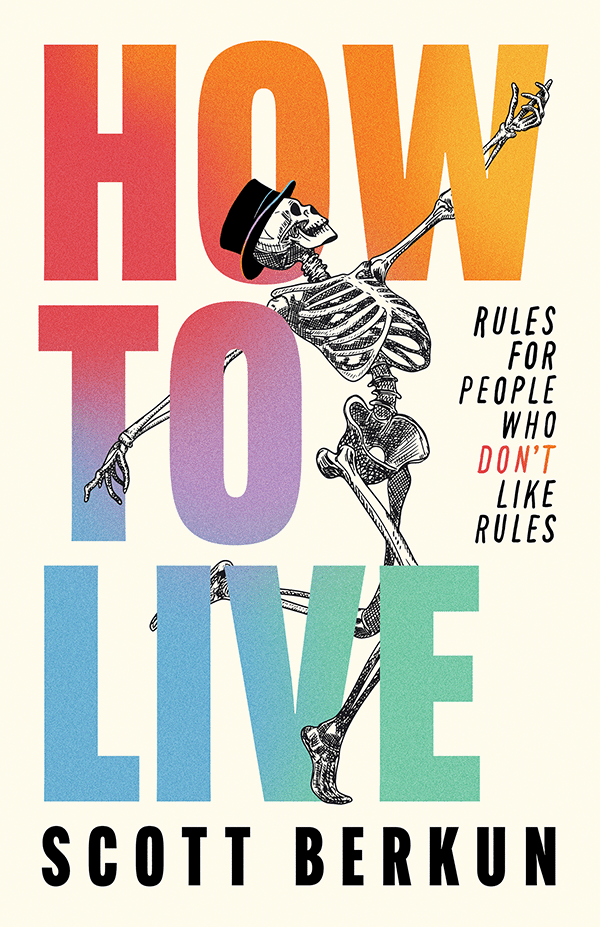
The first chapters of How to Live: Rules for People Who Don’t Like Rules. The book is out October 27, 2026, and you can pre-order or view the TOC.
“This book is full of wisdom and great advice for how to spend your years on earth… if you do heed even some of Scott’s advice… your life will be richer for it.” — A.J. Jacobs, bestselling author of The Year of Living Biblically
What are rules good for? In just one hour, on the second day of my senior year at Bayside High School in NYC, I broke two rules. I was a good student, but on that day, still feeling the joys of summer, I forgot to do my physics homework. My teacher, Mr. Sussman, was a bully and had a reputation for making fun of students he didn’t like. I feared teachers like him and tried to stay out of trouble, but on that day something changed. My rules for life were forming, I just didn’t know it yet.
Mr. Sussman had the crooked smile of a second-rate FBI interrogator. He wasn’t very tall or athletic, but in moments like this, where he felt that he had an advantage, he’d stalk the front of the classroom like an eager middle-aged chimpanzee. He calmly told me, and two other forgetful students, to stand up. He took his time, with long pauses as he moved around the room, telling jokes about how foolish we were. The class laughed with him. Eventually, he looked at me and asked, almost rhetorically, “How could you possibly forget on the first day?” And then something happened.
Without thinking, I spoke up. I replied, “Well, how could you give such a forgettable assignment?” The class laughed and gasped at the same time. They were shocked I did what many wished someone would do. I hadn’t planned it. I guess some part of me decided to defend myself. Mr. Sussman was mortified. He angrily pointed to the door while glaring at me and yelled, “You! To the dean’s office, now!” And I left. Being sent to the dean’s office was the ultimate punishment a teacher could give. But I walked out of the room in frustration more than fear. I didn’t feel good about what I had done, but it didn’t feel bad either. The interesting part of the story, given the goals of this book, is what happened next.
The dean’s office was empty so I sat and waited. I’d never been to the dean’s office before and didn’t know what the rules were. They weren’t posted anywhere, so how was I supposed to know them? Soon the class bell rang and an idea came to mind. Could I just leave? The whole idiotic exchange was a waste of time, and if I missed another class I’d have more catching up to do. Wasn’t the ultimate goal here for me to learn? I thought so, and I got up and left.
I chose to let the dean, Mr. Sussman, and whoever else was involved in the high school corrections system industrial-complex decide what rules I broke, if any, and what the punishment should be. Can you guess what happened in the end? Nothing. To my surprise, the whole incident never came up again, almost like it never occurred. I discovered that rules are not always what they seem.
My goal in this book is to teach you how to live well. Rules are good when they are wise and help us make good decisions. However, we don’t like rules when they are thoughtless, shallow, or serve only the people who enforce them, which is true too often. For this reason, the focus of this book is not the rules of institutions like schools, religions, or societies. Instead, it’s about what you can control: your inner life and your relationship with yourself.
I’ve learned that if you only live by your own rules, you live alone. But if you always follow other people’s rules, you never live your own life. So what is the answer then? It comes from finding balance, and I will help you do this. I’ve labeled the advice in this book as rules, because it’s the word that makes the most sense to me, but you could just as well call it wisdom, principles, guidelines, or philosophies. These are not restrictive rules, telling you what you can’t do. Instead, they are empowering tools for living well.
Here’s all you need to know about me. I’m 54 years old. I’ve had a great life, far better than I ever dreamed in Mr. Sussman’s class. I’ve spent 20 years traveling the world to talk about ideas from my books, meeting fascinating people and having experiences that opened my mind. I’ll use stories from my life, since I know it better than any other, to give you what the great philosopher Montaigne might call an “honest book.” I am well aware that what worked for me is not guaranteed to help anyone else. With that in mind, I’ve crafted the rules in this book to be as useful as possible for everyone.
Part One
While I was dying in the ICU of a hospital in Pittsburgh, I was surprised at the noise of the machines that were keeping me alive. Each one had a different yet equally annoying sound. All I wanted to do was rest, but every machine insisted on reminding me incessantly that it was doing its job. BEEP (I am checking if your heart rate is safe). BLOOP WHIRR CLANK (I am transfusing blood for you). There were five of these devices, and I was grateful for all of them, but did they need to be so loud? Each one had a different tone and rhythm, as if some mad genius composer had crafted a symphony for torturing people while they fought for their lives. I tell you this not to complain, I’m grateful for these inventions, but to teach you the first rule of this book.
One night, they needed to move my bed to do some tests that would reveal if I was healing. They unplugged many of the machines and moved me into a long, empty hallway to wait for testing. Finally it was quiet and I was alone, free from the endless poking and prodding from doctors, nurses, and family. It was peaceful at first, but soon I realized that without those monitors I could die. I’d lost so much blood and was severely anemic, which meant my heart could fail. And if it did, no one would know and I’d be gone forever. I was young, and one fear led to another. I convinced myself that if I fell asleep, as much as I wanted to, I’d never wake up. I kept my eyes open, fighting through tears to stay alive.
I am glad I did not die. And I am glad that you, dear reader, are not dead either. Which leads to the first rule of How to Live.
1: Don’t Die
If you think this rule is obvious, you’re mostly right. One way you’re wrong is that most of the universe has broken rule number one. Of all the people, animals, and species who had a chance to live since time began, more than 99.9% of them are currently dead. 150,000 people will die today, more than you could meet in several lifetimes. To all of these dead people and creatures, your existence is a triumph. You have won a great victory in the history of the universe just by being here. Good job.
The legendary TV show, The Sopranos, notable for how miserable every character was, popularized a wise observation: “Sometimes I go about in pity for myself, and all the while, a great wind carries me across the sky.”1 Being alive is our great wind. Any day we wake up and are not dead, or in great pain, is a victory. It seems obvious until we realize that most of our waking hours are spent taking life for granted. You could’ve been born a third-generation slave, tortured and worked to the bone every day of your life. Or watched your young family die of the plague, a terribly painful disease that consumed you last. Humans are a silly species, and our habit of forgetting the most important things is among the silliest.
One selfish reason I’m glad you’re not dead is that dead people do not buy books. Dead people do not seem to read well either; they get terrible scores on reading comprehension tests. Writers write for the living because there’s no sense in writing for the dead. The dead are out of chances. If you die midway through this sentence, and break this first rule, I cannot help you. But assuming you are alive, and not just a dead person pretending to be alive to impress your dead friends, you still have chances to turn things around. You never know how many chances you will get, but one can be enough, and my goal in this book is to help you use it.
I realize that “don’t die” sounds negative. It could be more positively stated as stay alive, or love life. But describing death as something to avoid makes me laugh, and laughing about death helps me laugh about life. Laughing means your mind is open. We only laugh when we can look at something in more than one way, but too often we get stuck on one narrow perspective. Something bad happens and we cry out, “Why me?” and obsess about our suffering. “Why not me?” is more reasonable to ask because we know everyone gets their turn. There is a reason the Budai, the Laughing Buddha, is always shown having a good time and giving gifts. He knew there’s a way to see the humor in all things, and when we do, life gets better.
This is similar to the spirit of the saying “God is a comedian playing to an audience that is too afraid to laugh.”2 Why fear something, like the unknown, if laughing at it is more helpful? If being afraid benefits you, then, by all means, tremble at your own shadow all day long. But if it makes things worse? Shouldn’t you try something else? Nietzsche wisely advised us to only believe in a god that can dance.3 Our gods are pictured as miserable, scary, and judgy. But what if they were dancing? It’s harder to judge others while dancing, even if they are bad at it, and this is true for both gods and people. Even Jesus, in his first miracle, made wine from water. I’m sure he was amused when he did it; it’s an act of joyous mischief to save the day at a wedding but keep it a secret.4 Yet I’ve never seen a painting of him smiling. Why is that?
And while I’m criticizing uptight philosophies, I can’t give a pass to the Stoics, the wisest wet blankets we have. Seneca, the most fun of a stiff bunch, wrote that “The man who laughs at [life], rather than mourns, does more service to the human race.”5 He’s telling us that humorless people are already partially dead. The very fact that we forget that survival itself is an achievement is funny and absurd. On days when life seems hard, cruel, or pointless, we can try to remember the ridiculously small odds of being alive, and enjoy it, even if the best we can do is find clever ways to complain about our disappointments. Much of the best art and music, works that help us appreciate life, are made by people having a rough time (e.g., most comedians are miserable). Art is their therapy and a gift to us all. But we compulsively take life for granted, justifying this first rule.
Even though I love being alive, I don’t wish for immortality. It’s a terrible idea. Kafka wrote, “The meaning of life is that it ends,” and I agree (although he’s a tricky source on how to live, since he was unhappy most of the time6). Scary movies are thrilling to watch because the fear of death they evoke helps us to feel alive. Without that fear, without the prospect of it all ending, we’d be more depressed and lost than ever. Death, and the awareness that all things end, creates meaning.
For example, if you felt this book was wasting your time, I’d apologize. However, if you were immortal and had the same complaint, I’d feel that you were wasting my time! For an immortal, time would be worthless. For me, every minute lost is irreplaceable. I’d pity you, because I’d know that as an immortal, your life would get increasingly empty as you aged. You’d either endure the endless grief of watching everyone you care about die, or you’d fade into an emotionless zombie who cared about nothing.
If we all lived forever, we’d be more selfish and cruel to one another, as death motivates us to care about consequences. I don’t believe in an afterlife either: it’s just too convenient and boring (as David Byrne wrote, “It’s a place where nothing happens”7). Even if I did believe in it, I’d think it was a bad idea, as it’s just another flavor of immortality. Instead, I look to nature. In the old-growth forests of the world, when the most majestic trees fall and die, they become nurse logs, helping new trees grow and find their own light. But if those trees never fell, they’d selfishly take up space and resources without offering anything in return.
If you wanted to nitpick, you could say the rule should be don’t die, yet. That’s fine. Nitpicking is a sign you’re reading more thoughtfully than dead people do. Well done. Another way to put this is that the denial of death is the denial of life. Millions of people struggle to enjoy a single hour of their day, yet they obsess about living longer instead of better. Or wiser. They just want MORE. We live longer than ever but are probably more miserable than ever too. And as we get more, and get better at counting it, we forget to value what it’s all for. This explains why rich people often have terrible taste. It’s like the sad businessman from The Little Prince, who owned most of the stars in the sky but never loved them.8 Why? In his obsession to own them all, he forgot to notice, not even once, the wonder of how they shined.
We love our dogs and cats because they enjoy life without extensive resumes or worn-out passports. They don’t care about careers, impressing their neighbors, or finding their purpose. Dogs are particularly worthy for their Sisyphus-defying ability to delight in the repetitions of life, thrilled every single time we come home or they get to go outside to chase a ball. Their enthusiasm for life is unparalleled. We admire children for being present in every moment without having to first listen to wellness podcasts or fly to Mexico for ayahuasca yoga retreats. The first question of wisdom to ask then is: why do all living things seem to know how to live well except us? Why does being a person, the supposed pinnacle of evolutionary achievement, often feel like a fight for happiness against the universe?
Alan Watts, the legendary, self-described philosophical entertainer, once wrote:
The meaning of life is just to be alive. It is so plain and so obvious and so simple. And yet, everybody rushes around in a great panic as if it were necessary to achieve something beyond themselves.9
Where does this panic we feel come from? This is explained by the second rule.
2: Wake Up
One of the worst days of my life was the day I graduated from college. After years of sacrifice and hard work, I had no job, no friends, and no prospects. All my classmates, including my Pittsburgh housemates, Ben, Ed, and Jeff, had flown away. They left to start careers, chase dreams, or spend their summer with family. My parents had just driven away to return to NYC, leaving me alone, with no one to celebrate with on that hot, humid night.
As the sun set, I stood on the balcony of my empty apartment, drinking cheap whiskey by myself, looking longingly at the Carnegie Mellon campus. I struggled to accept that I was no longer a student there. I felt alone in a way I had never felt before. For hours, I mindlessly watched cars drive by my street. It seemed that everyone had somewhere to go except for me. As the sky darkened, I struggled to understand why it felt that the earth had fallen away beneath my feet. I was too ashamed to talk to anyone about it. I was in shock at discovering how empty life could feel. I had followed life’s rules, yet somehow here I was.
The panic Watts describes is easy to explain: it’s the fear of not meeting the expectations of other people. I suffered that day because I had worked hard to ensure that graduation would be the beginning of my real life. When we are young, we are told that being real is something we earn. We have to find an impressive career or a meaningful purpose with sufficient social status. To go home to live with my parents again meant, at least in my mind, I had lost the game of life. And standing on that balcony, I felt like a loser. There are many flawed stories we believe about ourselves when we are young, and many people never outgrow them. Author Tara Brach calls this the trance of unworthiness, and we need help to snap out of it.10
Many religions tell us that we are born flawed from the start and will be damned to burn in hell, for eternity, if we don’t fix ourselves. How crazy is that? It would be too cruel to treat puppies or kittens that way, yet we do it to our own young. In Japan, it’s illegal for parents to threaten children with sayings like, “You will go to hell.”11 They consider it a form of abuse.
Deep in our culture, there’s a system of fear that tells us we’re always behind.12 We’re constantly told we should be smarter, prettier, wealthier, and more productive. But we aren’t given trustworthy maps or reliable guides to achieve those things, so who wouldn’t feel panic? Or feel that they don’t belong? We judge beach bums and the homeless for “doing so little,” for failing to achieve in a capitalistic sense, but isn’t that better than the people we applaud for being productive and successful by hurting the world?
Obviously, I did not die in that hospital bed or on my graduation day 30 years ago. Between then and now, I’ve had a great life. But I needed to wake up. I needed to feel Watts’ panic and then deconstruct it. It wasn’t until weeks after my college graduation that I realized I simply needed to start over. And to see that, despite feeling that the world had ended, it actually had not, only my illusions of it had. I was actually quite privileged to go to college at all. So what if I didn’t have a job? So what if I was alone? So what if I had college debt? So what, so what, SO WHAT? I was breathing and my heart was beating. I had fallen asleep in my life, a bad dream of unrealistic pressures, but now I was awake.
Earlier, I told you this day was one of the worst of my young life, but it would also turn out to be one of the best. In time, I discovered more about life and myself than I ever had before because of that experience. I was forced to question what was driving me to work so hard, and if it was serving me or someone else. And there was no other way I could learn it. Feeling like a failure opened my eyes. They might have never opened so wide otherwise. If they hadn’t, I doubt that any of my books would exist or that you’d know my name. Seneca wrote long ago that without misfortune, “[you can never] know what you are capable of,” and I know this to be true.
Waking up is the second rule in this book because it’s so tricky to follow. We may claim we want to wake up, but when given the choice, we stay in our delusions. We like our comfort zones. Awakening often requires something unexpected, a tragedy or shock, where we’re forced out of our slumber. The Jesuit priest, Anthony de Mello, wrote that many of us are born, live, marry, breed, and die without waking up or even knowing we slept through the whole thing.13
Here’s a related story: at my gym, there’s a scale in the locker room. I often see men, wearing only a towel, step on the scale to check their weight. They look down at the number and frown in disappointment. Then they step off the scale, take off the towel, and step back on! What are they doing? They are staying asleep. We all have little lies we tell ourselves. We say we want one thing and then we do something else.
When we stay asleep, if there is something we don’t like, there is always someone to blame: a parent, a teacher, a boss, or a system. Waking up means you look inside yourself with your eyes open. You finally say: here I am, this is what I am truly like, and here is what is really happening. Alan Watts also said, “You’re under no obligation to be the same person you were five minutes ago.” That is what a person who is awake can say to themselves. The past is only in your mind, and only you can let it go.
We often lament our regrets, chastising ourselves by saying, “What was I thinking?” When instead we can say, “Now I am awake. I know more. What action do I want to take now?” Maybe there was no other way to learn the lesson. Be glad you learned it at all. You are awake and can grow from the past instead of being a zombie. Awake people have more choices, and more ways to live well, than those who stay asleep.
Waking up can be fun too. Remember your first orgasm. Who knew a body could feel like that! Or the first time you had a vanilla milkshake or chicken tikka masala. Or when you read a book, heard a song, looked at a painting, or saw a movie that opened your mind so wide that you realized the world was inviting you to a lifetime of discoveries. When you are bored or depressed, it may mean you have fallen asleep in ways you didn’t realize. WAKE UP. Wake up, wake up, wake up.
Our sad friend Kafka once wrote to a friend that “a book must be the axe for the frozen sea within us.”14 Breaking that ice is one way to think of waking up. And it’s when that ice is shattered that we transform. Our fears grow in the dark under that ice, and we work hard to bury those fears. The musician Aimee Mann said, “Of the strategies for keeping safe, denial is the least effective…people spend enormous energy keeping things hidden.” That ice gets heavy and weighs us down. And by the time we try to face what’s underneath, those feelings are powerful and sharp enough to cut us to the bone. Rumi wrote, “The cure for the pain is in the pain.” All of the avoidance we do, over years, is far more painful than just feeling the feeling we’re afraid of in that moment and getting through it.
But there is good news. When we use that axe, and are brave enough to accept what we find underneath, we can be free to live the life we desire. Buddhist nun and writer Pema Chödrön tells us we should approach our frozen seas with warmth rather than violence.15 After all, we put that ice there out of self-love, to protect ourselves, even if it has become more of a prison than a sanctuary. With warmth and humor, over time, the ice will melt and crack on its own, allowing us to move through it with grace. It helps to remember that the comfort zone we are in now was once a place we feared.
3: You Are Not Your Thoughts
I’ve studied philosophy most of my life, and I’ve often wondered what it would be like to lose my mind or have the mind of someone else. Haven’t you? And as they say, like the Greek myth of King Midas, be careful what you wish for.
As the Covid pandemic was winding down in 2021, my right vocal cord was accidentally paralyzed during neck surgery. I could only speak in a quiet, raspy voice. I’ve lived as a loud, energetic New Yorker all my life, making my living as a public speaker, and this loss was devastating. With this disability, social situations, like ordering a drink at an empty…
That’s where the excerpt ends. Yes, it was kind of unfair to cut off that chapter right as it was getting interesting. Sorry about that. There are 23 more rules where these came from, and the whole book is 104 pages, so you’ll actually finish it.
Timeless praise for How to Live
Laudes a mortuis — praise from the dead.
“I think, therefore I bought two copies.”Descartes
“Took a real weight off my shoulders.”Atlas
“I predicted this book would be brilliant but no one believed me.”Cassandra
“The only thing is that I know nothing — and this book has doubled my knowledge.”Socrates
“I’ve been through a lot. This helped.”Job
“To buy or not to buy? That is the question. Mark me: five acts and eight funerals did my awakening require. Thine awaits in under 150 pages.”Hamlet
“Not the best of all possible books, but it’s pretty close.”Voltaire
“Worth reading over and over. Five stars. Same five stars tomorrow.”Sisyphus
“I finally found a book about my favorite subject: how I should live.”Narcissus
“Que sais-je? My cat and I enjoyed this immensely.”Montaigne
“You cannot read the same book twice, but if you could, this one would be worth it.”Heraclitus
“I opened it. No regrets.”Pandora
Notes
- The Sopranos, Season 6, Episode 3, “Mayham,” directed by Jack Bender, aired March 26, 2006, on HBO. The quote appears as an anonymous note in Tony Soprano’s hospital room. It’s attributed in the show as an Ojibwe (an indigenous people of North America) saying, but this is likely made up. I couldn’t find any reference to this quote prior to the show. ↩
- This saying is often attributed to the great Voltaire, but was actually coined by H.L. Mencken. ↩
- Friedrich Nietzsche, Thus Spoke Zarathustra: A Book for All and None, trans. Adrian Del Caro, ed. Robert B. Pippin (Cambridge: Cambridge University Press, 2006). ↩
- John 2:1–11 (New International Version). ↩
- Seneca, “On Peace of Mind,” in Dialogues and Essays, trans. John Davie (Oxford: Oxford University Press, 2008). ↩
- Gustav Janouch, Conversations with Kafka, trans. Goronwy Rees (New York: New Directions, 1971). ↩
- Talking Heads, “Heaven,” by David Byrne and Jerry Harrison, on Fear of Music (Sire Records, 1979). ↩
- Antoine de Saint-Exupéry, The Little Prince, trans. Richard Howard (San Diego: Harcourt, 2000). ↩
- Alan Watts, “Mysticism and Morality” (lecture, ca. 1963), transcript and recording, The Library of Consciousness. ↩
- Tara Brach, Radical Acceptance: Embracing Your Life with the Heart of a Buddha (New York: Bantam, 2003). ↩
- “Government guidelines define child abuse from religious parents,” The Asahi Shimbun, December 26, 2022. ↩
- Jason Pargin, Facebook post beginning “Everybody around you is scared for their own future, or for the safety of their own families, or they’re scared that they’re not good enough.” ↩
- Anthony de Mello, Awareness (PRH Christian Publishing, 1992). ↩
- Franz Kafka, Letters to Friends, Family, and Editors, trans. Richard and Clara Winston (New York: Schocken Books, 1977). ↩
- Pema Chödrön, The Places That Scare You: A Guide to Fearlessness in Difficult Times (Boston: Shambhala, 2001). ↩