Book Review: The New Kings of Nonfiction

I’m a big fan of essay collections and when I came across this one, cover of kings of nonfictionThe New kings of Nonfiction, edited by Ira Glass of This American Life fame I had high expectations.

The book is good. Three of Five stars. If you’ve never gone out of your way to pick up a book filled with non-fiction essays, this is a decent place to start. I’m a bigger fan of the Best American Essays series, which has never failed me. I enjoy being able to abandon authors or essays I don’t like, and try another in the next chapter. It’s like a writing sample pack: great way to discover new voices and different kinds of writing.

In Glass’s compilation you have Michael Lewis (Moneyball, Liar’s Poker) reporting on a teenage day trader arrested by the SEC, A Malcolm Gladwell essay that appears in The tipping point, and other essays by Dan Savage, Michael Pollan and more.

But by far my two favorite essays were from two writers I’d never heard of before. Losing The War (full essay online), by Lee Sandlin and Toxic Dreams: A California Town Finds Meaning In An Acid Pit, by Jack Hitt. The $10 you’ll pay for this book is worth it for these two superior pieces of funny, clever, tightly written, truly thought provoking works. “Losing the War” explores a truer history of heroes and WWII than most of us know, while “Toxic Dreams” is the story of one of the first toxic waste dumps, and how the imact on the town nearby slowly unraveled over more than a decade.

Have a novel in you? Prove it (National novel writing month)

In about a week, hundreds of folks will start working on a new novel, writing about 1500 words a day as part of National Novel Writing Month (aka NanoWriMo). It’s a great way to kick yourself into gear, and use the collective morale energy of other amateur and pro writers to psych yourself into overcoming writers block, get in there and just write.

The FAQ will answer all your questions. Sign up is free – there are forums for support, you can track your friends daily writing progress and more.

I’ve met Chris Baty, the founder of NanoWriMo, and the whole thing they’re doing here is fantastic.

If you truly want to stop talking about writing and do it, here’s the best chance you’ll have this year.

See also: How to write a book – the short honest truth

Luddite news: My new cell phone is…

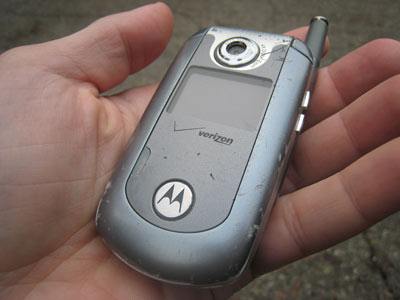
I’ve owned one cell phone in my life – This Motorola something or other. I bought it in 2003 when I quit my job. Back then, I bought it mostly because my wife got the same one – she’s smart, and on average copying what she does works out well.


Motorola phone

When the recharge jack died and the phone overheated after a long plane trip, it was time to shop. I knew I needed the following things in a new phone:

  1. Dead simple ease of use for my 75% usage: calling and talking to people.
  2. High durability. I never want to worry about dropping something I carry in pocket. Look at the scars on the above photo: that’s the mark of a well used, well built piece of technology.
  3. Any fancy features never get in my way.

I spent 4 months looking at phones in person and developed the following simple test, knowing it represented 90% of what I’d use one of these things for:

  1. Make a phone call
  2. Send a text message
  3. Add a contact
  4. Type in a url, view it and add it as a bookmark
  5. Look up the map for an address
  6. Add an appointment
  7. Sync to my desktop PC

If any of the above took more than 30 seconds to figure out, or seemed like it would take 30 seconds to figure out every time, I gave the phone a failing grade. I looked at dozens of phones and 95% of them failed this simple test for me.

The only phone that passed, was the one I bought last month – The Palm Centro:


Motorola phone

I’ve had the phone nearly a month and I’ve been very happy. It’s slightly bigger than the Motorola, but still fits easily in my jeans pocket. The phone doesn’t have some of the latest super cool features and whatnot, but I really do not care – for what I actually do, its been great. Simple, simple, simple, with many thoughtful UI design elements. Hopefully the phone will last me, like the last one, another five years. While it lacks GPS, there’s a google maps update that gives you 300 yard accuracy by pinging cell phone towers, good enough for every situation I’ve been in so far.

Many friends point me to the Blackberry, but even the latest models were larger than the Centro, much harder to use, and their UI was downright ugly. The Palm UI, from fonts to layouts, has a superior level of care. As much as I wanted to like the Blackberry, by my standard above it wasn’t close.

I did look at the Apple i-phone, and while it looks great and has some excellent design aspects, it totally failed #2 above. I’d scratch that screen in a day, and drop the phone in a week, and after killing two apple nano i-pods (call me the screen destroyer), I wasn’t convinced it would survive my travels. I also had problems with the touchscreen keyboard: I just don’t like typing on touch screens (YMMV). It seemed designed well, but Centro’s keyboard, despite all my instincts against mini-keyboards, worked super well even with my extra-large hands.

(See my follow review months later)

Wednesday linkfest

Late bloomers vs. Young geniuses (Critiquing Gladwell, Part 2)

Gladwell’s article, titled Late bloomers: Why do we equate genius with precocity?, makes one major mistake in not addressing the questions researchers have about the notion of genius. Entire books have been written with the premise that there really is no such thing as a genius in the sense most people use it, and that the distinctions of ‘prodigy’ and ‘genius’ are so abused and misunderstood as to be useless.

This essay uses the idea of ‘the young genius’ as a point of leverage for late bloomers, suggesting that you are either one or the other (this is the core thesis of economics professor David Galenson’s book, Old Masters and Young Geniuses, whom Gladwell quotes in the article). Dualism of this kind is dangerous and nearly always misleading. It brings to mind that old joke: there are two kinds of people in the world, those that think there are two kinds of people in the world, and those that don’t.

The more I’ve studied creative thinking the more convinced I am these sweeping categorizations are 1) supported by selective research 2) not the best tools for those who want to follow creative paths themselves.

Gladwell wrote:

Picasso was the incandescent prodigy. His career as a serious artist began with a masterpiece, Evocation: The Burial of Casagemas produced at age twenty. In short order, he painted many of the greatest works of his career, including Les Demoiselles at the age of twenty-six. Picasso fit our usual ideas about genius perfectly.

But what are those ideas? He doesn’t say. I think most people imagine young Pablo, if he were a genius, learning to paint largely on his own. I think it’d be a surprise to learn his father was a painter, and taught Picasso to draw and paint from a very young age, sent him to an excellent art school as a youth, and encouraged his trips to Paris, where he quickly made an amazing assortment of connections in the art scene before he was 25. Similar family and community support can be found in the story of Mozart (his father was also a musician who trained him early). Who your parents were is hugely significant in the history of prodigies and geniuses.

Another fact that doesn’t usually fit our idea of genius: at the time Picasso painted Evocation, he was basically starving in Paris, in a situation similar to Van Gogh’s a few decades earlier, faced with the choice on many mornings of buying food or buying paint. Picasso had been working seriously, by most definitions, for years before Evocation was finished. We don’t think of people with prodigious, gifted talents starving and struggling, but there he was. Another counterpoint is that Picasso had a ridiculously vibrant painting career that spanned decades – one of his greatest works, Guernica, was made at the age of 56. The passage from Gladwell hints that his 20s were his best work, but that’s not true. It was an intense time of productivity, but not the only productive time in his life.

Gladwell continues:

Prodigies like Picasso, Galenson argues, rarely engage in that kind of open-ended exploration. They tend to be “conceptual,” Galenson says, in the sense that they start with a clear idea of where they want to go, and then they execute it. “I can hardly understand the importance given to the word ‘research,’ ” Picasso once said in an interview with the artist Marius de Zayas. “In my opinion, to search means nothing in painting. To find is the thing.” He continued, “The several manners I have used in my art must not be considered as an evolution or as steps toward an unknown ideal of painting. . . . I have never made trials or experiments.”

This is an outright contradiction of Picasso’s performance in the documentary The Mystery of Picasso, where he spends 70 minutes revealing his creative process as a series of experiments, risks and gambles. Over the course of an amazing hour we see him take risks, make mistakes, and continually reinvent and change individual paintings. It’s a rare and amazing thing for any artist to expose themselves in this way, much less the difficult and reclusive Picasso, but he seems, on camera to take deep pride in his creative experimentation.

Nothing can stop Picasso from having contradicted himself, but if he did, both ends of the contradiction have value in this discussion.

More to my point, there is a huge inventory of creators who have been called geniuses who mention experimentation as a critical to their creative process. They include Frank Lloyd Wright, Hemingway, David Byrne, Miles Davis, Paul Simon, and on it goes.

Finally, Gladwell offers:

This is the final lesson of the late bloomer: his or her success is highly contingent on the efforts of others. In biographies of Cézanne, Louis-Auguste invariably comes across as a kind of grumpy philistine, who didn’t appreciate his son’s genius. But Louis-Auguste didn’t have to support Cézanne all those years. He would have been within his rights to make his son get a real job, just as Sharie might well have said no to her husband’s repeated trips to the chaos of Haiti.

But what is not mentioned is the amazing social network that enabled and supported young Picasso to do what he did. Dependence on the effort of others is not a factor exclusive to late bloomers. On his first trip to Paris, he quickly met Max Jacob, who taught him French and French culture – they’d share a room for years. He had many friends in the art scene in those early years, including Andre Breton (founder of surrealism), Gertrude Stein, and Henry Matisse. Not a bad crowd to get advice from for an artist in his 20s. He also befriended artist George Braque, and through collaboration they would develop a little thing called cubism together.

(Hat tip, Ario)

Related:

Quote of the month

This is what politics is to me. Someone tells you all the trees on your street have a disease. One side says give them food and water and everything will be fine. One side says chop them down and burn them so they don’t infect another street. That’s politics. And I’m going, Who says they’re diseased? And how does this sickness manifest itself? And is this outside of a natural cycle? And who said this again? And when were they on this street? But we just have people who shout, “Chop it down and burn it” or “Give it food and water” and there’s your two choices. Sorry, I’m not a believer.

– John Malkovich, Esquire Magazine, Nov 2008

Why Designers Fail: The Report

Why designers succeed and fail in organizations is mostly a matter of opinion as there’s little data to support theories or make claims. To help ground discussions on this subject I ran a research study on why designers fail – exploring the psychological, skill and organizational reasons why designers, and people who work with designers, believe designers don’t achieve the results they desire (PDF of survey questions here).

Update: this research was originally presented at UIE 13,  and also at MX ’08, An Event Apart Seattle ’08 and ’11. The latest version of the slides can be downloaded here, and this is the written sumation.

Top line summary

The survey consisted of 41 issues, divided into three categories: Psychological, Skill and Organization. Each participant ranked each issue on a scale from 1 to 5, with 5 meaning the issue was highly significant in explaining why designers fail, and 1 meaning least significant (3 was identified as a neutral value).

The 389 survey respondents self identified as (rounded up #s):

Designer 34%
Project manager 17%
Programmer / Tester 12%
Usability engineer 10%
Group manager 7%
Business / Marketing 4%
Documentation 1%
Other 17%


The top 16 issues, ranked by average scores were:

People in non-design roles making design decisions 4.18
Managers making design decisions w/o design training 4.14
Designers don’t seek enough data before designing 3.92
No time is provided for long term thinking 3.81
Not receptive to critical feedback 3.69
Lack of awareness of the business fundamentals 3.66
Only lip-service is paid to “User centered design” 3.64
It’s never made safe to fail or experiment 3.62
Designer’s power diluted by too many cooks 3.60
Over-reliance on one kind of design style 3.54
Poor collaboration skills 3.51
Poor persuasion / idea pitching skills 3.49
Poor communication skills 3.49
Poor understanding of domain 3.48
Pressure to use first solution, not a good solution 3.45
Big Ego / Expects others to cater to their whims 3.41

Average scores per grouping

The average scores for groupings showed little different in weightings: there was no single grouping of issues that proved to be significantly more important in explaining why designers fail.

Organizational issues: 3.37
Skill issues: 3.15
Psychological issues: 3.11

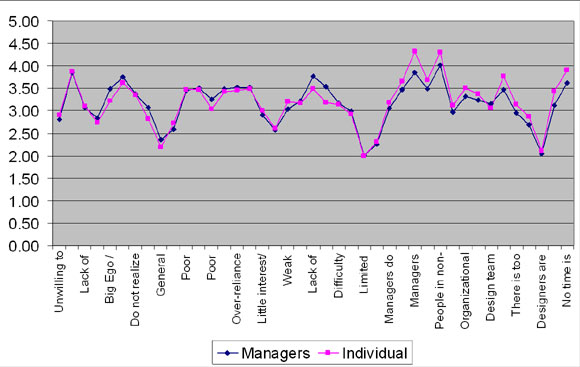
Managers vs. Individual contributors

(Note: these charts are quick and dirty. If you’d like the raw data to generate better ones, just ask).

One research question of the study was to see how individual contributors and managers varied in their thinking on failure. 49% of those surveyed identified as playing a lead or management role.

The results showed extremely high correlation between the opinion of individuals and managers.

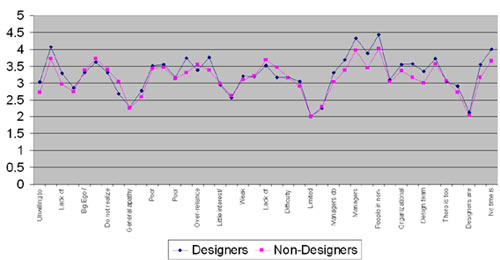
Designers vs. non-designers

Another research question was how designers and non-designers results would compare. The results showed only minor variance in how designers and non-designers view causes of failure.

The results showed extremely high correlation between the opinion of designers and non-designers on why designers fail.

Conclusions

  • Many top reasons for failure are not typically considered design issues, such as collaboration skills, persuasion skills, and receiving critical feedback.
  • General consensus on top issues: managers, non-managers, designers and non-designers all had highly similar scores.
  • Nearly half of all respondents took time to write in additional issues and thoughts. There was a great deal of interest in discussing this topic further.

Background and Disclosures

  • This survey was designed primarily for qualitative use and as a basis for further discussion and research. I’m sure there are flaws and bias in the study design but I believe this study is valuable anyway.
  • The issue list was based on 3 things: my own experiences managing UX design training for Microsoft from 1999-2002, many years of debating this question at drunken design conference receptions, and this discussion on a previous blog post.
  • The issue descriptions listed above were modified to fit in the post – see the actual survey if you’re suspicious of leading questions or other survey bias issues.
  • The survey was distributed via this blog, the iXda mailing list and the pmclinic list.
  • A PDF version (95k) of the actual survey can be downloaded.

You can download the slides from from my talks on this at  UI13 and an An Event Apart Seattle. 

I’m looking for folks to help continue this research. If you’re interested leave a comment.

How to design an office for designers?

One question that came up at my session on Leading breakthrough projects at UIE 13 last week was how to design an office for a team of designers.

I’ve been asking around but haven’t found either a well written description of what a manager decided and why, or some research into how to structure spaces for creative teams.

Joel Spolsky’s writeup on the Bionic office comes close, but it’s written about designing an office for programmers, not creative types in general. This is a great start but I’m looking for more.

If you know of other writeups of office redesigns (including how to design a design studio), or research into how to design a workspace for creatives, please leave a comment. Cheers!

Win prizes! – Why do designers fail SURVEY

After a most interesting thread and side e-mails, I’ve developed a survey to more deeply explore the reasons why designers fail. There are now over 40 specific causes offered, and I need 5 minutes of your time to better understand how these causes relate to the real world.

Details:

  • The survey is open to designers and non-designers.
  • Goal is to better understand both causes and perception of causes of failure.
  • Prizes: $100, $50 and $25 Amazon.com gift certificates.
  • Survey has 7 questions, all multiple choice, and should take less than 5 minutes
  • You can be anonymous, but it you want a shot at prizes, put in your email.
  • Results will be presented at UIE13 next week – and on this site

Act now, the survey closes EOD FRIDAY. 

Survey – Why do designers fail? [Survey CLOSED]

(Note: If you try to take the survey twice on the same computer, it wont let you. You’ll get a “Thank you for taking the survey” page).

Why do designers fail? Input wanted

I’m finishing up my slides for a talk next week at UIE 13 in Cambridge, MA. The title is “Why designers fail and what to do about it”.

I’m sure there are a zillion reason’s designers, like any professionals, fail. What I’m looking for are habits you’ve identified in designers you think sets them up not to achieve what they seem to want to (making great, easy to use, things).

Here’s a sample of the long list I’ve identified:

  • Assuming other people understand design and care about good design
  • Not seeking power when power is required to deliver on an idea
  • Being shy / passing opportunities to pitch ideas
  • General incompetence (not as good at designing things as they think they are )

My goal isn’t to bash designers here, and in the talk I offer solutions & positive examples.

Instead here’s what I’m hoping for: there are many proffessional designers in the world, but not many things we can buy that are designed as well as i-phones and Porsches – why is that? How do designers fail, whether it’s their fault or not, to bring great things to the world?

I’m thinking there are 3 categories: Failures of the designer’s psychology, Failures of the designer’s skill, and failures of the organization.

Love to hear your opinions – thanks.

RSS/Feed issues: Fixed (details)

For a few hours today my nice little RSS Feed, with close to 20k subscribers, was replaced by a pile of ads for some record label called True Tiger Recordings.

As much as I often consider ditching the whole writing/speaking career to be a lead singer in a rock band, that’s not what happened today.

A few kind folks, Peter, Kirill, Dave, Adam, Neil, Greg, Meh (hey, that’s the name you left) – let me know almost immediately that something strange was up, and as I don’t check my own RSS Feed often, and they saw it well before I did. Thanks guys, I’m in your debt.

Continue reading

Wednesday linkfest