
Job loss map (coolness & badness)
Found this great post from Slate’s Moneybox via Brady @ O’Reilly.


I think Tufte would be happy.
You can and should play with the interactive map yourself.
Found this great post from Slate’s Moneybox via Brady @ O’Reilly.
I think Tufte would be happy.
You can and should play with the interactive map yourself.
Here’s the calendar for the next few weeks:
Here’s this week’s linkfestage:
Tomorrow, April 14th, I’m doing a live webcast for UIE on Why designers fail and what to do about it. This will be 90 minutes of lessons on how to learn from other people’s failures, how to become wiser and better than your annoying co-workers, and learn to take more pleasure in experimentation and creative thinking as a creative person. There will be some new twists and updates specially designed for this webcast, includes tactics and approaches to thinking about failure.
If you sign up you get some free consulting time from me after the webcast via email. That’s a sweet deal all on its own.
For this 90 min live talk, including live Q&A, a talk you can participate in from anywhere in the world, wearing only your underwear if you choose as I won’t be able to see you, for $129 – If you use the promo code (BERKUN) it’s only $99! Wow!I just saved you $30!
Here’s my fun promo video for the session, with audio voiceover, including a last slide that details the value you’ll get from tuning in.
Details and registration info here – Use my promo code BERKUN to get the discounted price of $99.
Any questions? Fire away.
A new post up on speakerconfessions.com is all about panel sessions at conferences and how to fix them: Why panel sessions suck.
I was invited to speak at Microsoft’s Asian Pacific Leadership conference last week, an internal employee only event, and spoke in the McKinley room to a swell crowd of about 300 people. It was a nice event – kudos to all the organizers.
At the end of the talk, late in Q&A, someone asked about schedule estimation. You know, tricks for how to better predict how long things take.
After hemming and hawing, I mentioned wideband delphi, a good technique for teams.
The gentleman asking the question looked confused. I asked the audience. No one had heard of it either.
So I then say the last thing you should say:
“Oh. Just Google it.”
The entire crowd gave me a good spirited “booooo”. Had there been a list of 5 things not to say, other than to ask about Vista PR or Zune marketshare, this would have been top of the list.
Which I thought was embarrassing, but funny. I find it funny when I do really innocent, but stupid things. I apologized, and felt bad, but it is in it’s way, comedy. A few people yelled out “Live Search!” to try and help me out. But I’d already blown it.
Hey, this stuff happens, especially during the spontiniety of Q&A.
Many conferences include what’s called a panel session. This is where 3 to 5 experts get up on stage and each one, in turn, bores the audience to death.
Why do panels still happen? One reason: they’re sooooo tempting. In theory a panel is great. It gets more people on stage, which should magically creates something real, engaging and spontaneous.
Why doesn’t it work? Here’s why:
How to run a great panel session:
At the end of the day, good panel sessions are work. If the organizer is also the moderator, the investment required to make the good will get dropped before other responsibilities. It’s a great assignment to give away to someone, perhaps for free admission to the event.
I happen to love moderating panel sessions. I bet other people do to. A wise conference organizer will find these people, given them free admission for their services, and get out of the way.
References:
(This post was first posted on speakerconfessions.com)
Microsoft recently announced the end of the product known as Encarata. Way back in the day Encarta was cool. It was one of the few things made in the CD-ROM era that, looking backwards, made sense (Yes, I owned a copy of both Art Gallery and Microsoft Dogs, and as idiotic as it seems now, the later actually got good reviews) – and was actually designed quite well.
It’ was also a curiously successful work of innovation by Microsoft on several counts. Few people remember, but Microsoft bet big on CD-ROMs and consumer software, and of those efforts, many of which flopped, Encarta was a gem. In 1994 it demonstrated many of the things people had been promising PCs would be good for (multimedia, education, instant access to information, etc.). There were other encyclopedias, but (I don’t think) anyone else invested as much in the design and technology as Microsoft did.

Many forget, or were still in diapers, but in 1994, years before web design would be something you could say at a bar without people thinking you were into spiders, Encarta demonstrated much of what we call information architecture, interaction design and consumer aesthetics, all in one high profile consumer product. Many, many companies and software teams used Encarta as a reference for not only what was possible, but for what a good experience should be like. Microsoft didn’t invent many of the technologies involved, but the encapsulation of so many into a well designed experience is similar in some ways to the success of the i-pod. Both are examples of innovation through superior user experience and integration of various technologies made mostly by other folks.
And most importantly, when Netscape and Internet Explorer began the browser wars, many of us looked at Encarta as an approximation of what a great web experience should feel like, with rich media, consumer appliance simplicity, and great search and navigation. In the hallways on the Internet Explorer team we had screenshots of some of the Encarta team’s work, among various other bits of software inspiration, up on the wall. It was definitely a reference used in designing features like Explorer bars, Favorites & History.
Kudos to Bill Flora, Adrienne Odonnell, and Sheila Carter (who are listed here as the design team) and other folks who worked on this thing over the years.
Encarta also was one of the best product names Microsoft has ever had. Sure, that’s not saying much given how notorious MSFT is for lousy names, but like Excel (also a good name, at least it was in 1985, compared to Lotus 1-2-3) it somehow fit the vibe of the kind of thing the product was.
Can’t say I miss loading CDs into my PC (I can’t remember the last time I did that), but Encarta definitely deserves a notable place in the history of software design. They helped raise a bar many people still use today.
As a positive counterpoint to my list of why managers become assholes, and as a counterbalance to my tendency to write cynically, here’s a list of why people become great at managing others, trying as much as possible not to just do the reflexive act of merely inverting my other list.
Also see: Advice for new managers (A popular essay)
What did I miss? Think of the last great manager you had and what traits you’d add to the above.
I know I’m fond of criticizing the world. I have many posts with titles like Why X sucks and the myths about Y. Many writers do this too and I wonder why. A first pass suggests it’s easier to criticize than it is to make things.
For example, lets say we have two essays:
A) What makes managers great
B) Why managers make us miserable
Somehow the confession, by writer B, that there’s something wrong and they’re going to talk about it strikes me as more honest than writer A. Writer A sounds like a fool. A Pollyanna. He sounds like someone who thinks everything is wonderful and probably has no insight as to why. Whereas Writer B, although he might describe some horror stories, offers a chance at insight that might help turn things around.
I’m from NYC, and people from NYC are prone to skepticism. Simply put, if I don’t see you call bullshit on something, I fear you don’t know how.
I do realize this can get in the way, so I do my best not to go too far. I wonder what you think. Let me know.
“Plenty of what’s popular isn’t good, and plenty of what’s good isn’t popular”
One of the grand confusions of modern life is the confusion between what is good and what is popular. Most of the time people confuse being popular with being good, which isn’t necessarily true.
I knew a guy in high school. He was very popular. But I don’t think anyone would say he was good at anything. Not really.
I also knew another guy in high school. He was pretty good at lots of things. But for some reason, he wasn’t very popular.
I suspect if these two guys ever met the universe would have exploded. Good thing that didn’t happen.
The temptation many creative people have is to strive for popularity. To make, do, and say things that other people like in the hopes of pleasing them. This motivation is nice. And sometimes the end result is good. But often what happens in trying so hard to please other people, especially many other people, the result is mediocre. Their internal goodness detector is disappointed with what they make. And worse, sometimes the results are awful. Popularity often comes at a price: going for bland, crass, predictable and meaningless, instead of interesting, delicate, complex and meaningful.
And then there are the artistes. People who develop their own sense of what they think is good and insist on striving for it, no matter what anyone else says. Provided they don’t expect anyone else to care, these people are quite interesting. Although there is nothing worse than an artiste who insists on telling you how stupid you are for not seeing how brilliant their work is.
Digging through history I’ve found it interesting how characters like Van Gogh, Michelangelo, and Bukowski balanced the popular vs. good challenge. Most famous artists took commissions, and in some cases those commissions resulted in their most famous work (For example, Da Vinci and Michelangelo had clients and lived mostly on commission income. If you wonder why much of what’s in museums are portraits of old wealthy people, it’s because they’re the only ones who could afford to pay for paintings). In other cases, like Bukowski, Henry Miller, Van Gogh, they never really compromised. Sometimes to their own detriment.
But what most creative people want, all the ones I know, is to be both good and popular. They want to achieve their own sense of goodness, while at the same time pleasing other people. It’s a tightrope. Especially once you’ve been popular here or there, people tend to want more of the same. And that rarely fits in with a creative person’s sense of goodness. So a few big popular victories early on can put handcuffs on how good, from the creators standpoint, they can ever be while still being popular. My first book was on project management, and I suspect for some people, no matter how many books I write on other things, I’ll always be the project management guy. And that’s ok.
How do you balance your own sense of good vs. your sense of popular? Do you find clear places where they are in conflict (say your client’s sense of good vs. your own?) How to you balance this out and stay sane? Do you divide your creative energy into “work creative” and “personal creative”, giving yourself a safe place to be an artiste? Or is this more than you’ve ever thought about what is, perhaps, a silly and pretentious line of thinking?
Whatever your opinion, I’d like to hear it.
Link joy for your browsing pleasure:
New post is up at SpeakerConfessions.com about How to fix boring lectures.
I’ll be doing more “How to fix…” style posts so if you dig this, keep watching.
Got a question you want me to answer on public speaking? Let me know. I take requests.
We all know most lectures are boring. They go on too long, most speakers are dull on stage, and sitting in big dark rooms for an hour or more is not going to help anyone stay awake.
But if they’re so boring why do we go? We go because we have little choice. If we want to hear from an expert on something, either we read their books (possibly boring) or go listen to them talk (also likely boring). There just isn’t a Bill Nye the Science guy video for most people’s ideas.
But there are things a thoughtful speaker can do -Here’s some simple tricks to fix dull lectures:
See my speaker checklist for a great one page summary of how to prepare. Or read my other fine posts on public speaking.

To keep track of all the interviews, research and stories I’m putting together for the next book, I’ve set up a new blog called speakerconfessions.com.
Why the new blog? One reason. Public speaking is a polarizing topic – some people find it fascinating, others are bored to tears. Rather than annoy half of you here, it makes sense to have a place just about the topic.
If you’re interested in public speaking and communication, or want to contribute to a book in progress, definitely head over and pick up the RSS feed. If you’re not sure, stay here – I’ll post links to the other site now and again from here.
First up are notes from my interview with Jeffrey Veen, two time author and founding member of adaptive path, about his process for putting together talks and his experiences as a speaker.
One phrase I can’t stand is “We don’t have time”.
We all get the same amount of time every day. What differs from person to person is how they prioritize that time. I pick from the list of possible things to do with this hour, and the next one, and the one after that. But there is always time to do something.
This means that to say we don’t have time to do X really means X is not important enough to get time.
This second phrase is a very different. It expresses how the resource of time is prioritized. This invites a conversation about why one use of time might be better than another.
But often we used the phrase “I don’t have time” to avoid having to say more honest things like:
But people who say “we don’t have time” are saying it to avoid a conversation. They want, mostly, to blow you off and move on.
Case in point: If I told you I will give you a billion dollars for going to lunch with me tommorow, no matter what commitments you’ve made, you will likely change them so you can get the billion dollars. Time is not an issue – the priority of two competing things is. Depositing a check for a billion dollars will trump most everyday life commitments easily. And by the same token, a sufficiently brilliant idea would cause any leader to make changes, including adding more time to the schedule. The real question is whether the proposed idea is good enough to warrant change.
The Countermove: when told “We don’t have time” by a project manager or co-worker, the best questions to ask are:
All these countermove questions force a discussion and more importantly some thinking to take place. Any idiot can say “we don’t have time”, but only a good leader will happily explain why.
Obviously, pick your battles. On healthy teams people can intuit which of the first list of better phrases is actually meant, and on unhealthy teams, the dude who challenges every single decision, every single time, is going to be ignored for that reason alone. But if it’s a battle worth fighting, or it’s a habit you want people to start breaking, use your countermoves.
See also: “We don’t have money”, “We don’t have enough staff”
What phrases irritate you? Leave a comment.
I’m stuck in the Vancouver airport, waiting for them to find a new plane. Hard to complain about waiting for a new plane, when the old plane broke. Tell me the current plane might explode and I’m happy to wait, thank you very much.
Waiting at the gate, in between trying not to strangle the kid dancing precariously close to my luggage, and the guy with laptop problems on my left who has his volume set to 11 (I will be hearing the Windows startup song in my sleep), I made a sketch for ideas in organizations.
The arrows are the paths of different ideas. The box in the middle is the organization.
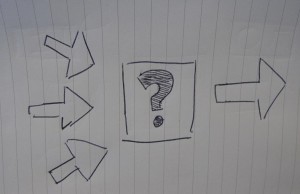
Whenever leaders want more innovation, they typically start by adding more inputs into the process. They seek out more ideas. Hey, let’s brainstorm! Or maybe we should crowdsource! Or how about getting everyone to mindmap!
Executives often do this flinchy sort of thing and it’s big news at many corporations to start “idea programs” to encourage people to submit ideas.
These programs are launched, ideas are submitted, and there is much rejoicing.
But little change.
The reason there is little change is that idea inputs were never the problem. The bottleneck was further upstream. Crowdsourcing, brainstorming, mindmapping, and the dozens of other techniques people obsess about help create early idea volume, but do little to help the curators, the people who winnow down the hundreds of ideas down to dozens, and dozens down to a handful.
It’s much more useful to study where the bottlenecks are, when and why new ideas are killed, and who the people are that are killing them.
If you have 1000 new ideas a month, but 0 prototypes are ever made from them, what good is another 2000 ideas? It’s much better to study why there is no time or rewards for prototyping and focus on getting that number to go up.
An easy diagnostic for innovation is the list of 10 stages – Where do ideas die in your world? That’s the place to study and make changes to help ideas survive longer in your organization.
The real challenge is getting ideas out the door – not how you generate ideas. It’s more useful to study how ideas die – what reasons are used? Who has the power to do it? And when and why are they using it?
Sorting out the lifecycle of ideas in an organization requires study and thought, while slapping more idea generation techniques on the front does not.
Last call for presentation camp – a brand new unconference event for people interested in pitching, presenting and public speaking.
Presentation Camp
At UW communications building (map)
Saturday April 4th 2009, 9am-4:30pm (Full schedule here)
It’s $15 if you register by noon today, $20 later today or at the door.
I’ll be doing a keynote on Why your talk sucks and what to do about it. And if there’s enough interest I’ll be doing a slide critique fun house, where we look at each others slides and help make them better.
Plus I’ll be around all day interviewing people for my next book.
In doing research for writing books you notice disturbing things.
Sometimes you discover a saying attributed to two different people, and the right attribution is actually less popular than the wrong one (In my case I misattributed the famous quote mistakenly believed to be Goethe – “Boldness has genius, power and magic…”). Other times people snip a quote in such a way that it is divorced from the context in which the writer intended.
One example is this famous saying from Emerson:
A foolish consistency is the hobgoblin of little minds.
The quote is from Self-Reliance, an essay about learning about yourself. Which is a good thing to do.
The problem is it’s easy to lob off those first two words and have a different quote.
Consistency is the hobgoblin of little minds.
Same sentence, different meaning. A meaning that Emerson never intended and clearly disagreed with. But by using this well worn phrase in a different way, some kind of violation of intention has taken place. It’s not what the author meant. The writer using the quote is co-opting the work of the other guy to suit his own purposes.
This problem can be minimized, but it’s hard to avoid entirely. There are too many misquotings in too many good or popular books, to either verify quotes before using them, or get secondary references for all sources. The web does help catch these things, but preventing them is another matter. How much responsibility do writers have to verify quotes?
The problems get worse with fiction.
There is a Stephen King quote bouncing around the web that goes like this:
God is cruel, sometimes he makes you live.
As best I can tell, the quote comes from a novel he wrote called Desperation. However another version of the quote is listed this way:
Do you know how cruel your God can be, David. How fantastically cruel? …Sometimes he makes us live.
Which version would you use? Probably the one that’s shorter. This sort of thing happens all the time, such as in the story of the quote known as Murphy’s law. Sometimes the quote gets better over time, even as it distances itself from what the attributed author actually wrote or said.
The surprise is that both versions can be found at the same source, wikiquote. Here’s the first and here’s the second. At least wikiquote attributes quotes to their sources, which many quote books and websites do not.
In any case the quote is from a work of fiction. King, the author, may have written this sentence for purposes that serve the book. He may not actually believe this sentence. Or maybe he does. Only he knows. You can find similar quoting issues where an author gets attributed for something one of his character says, which is really quite a different thing than saying it themselves.
For the writers out there, it’s worth taking a moment to find out where a quote comes before you use it. Even just to know what book it’s from, and if it’s fiction or non-fiction. If you’re using a quote as the main anchor to support your major point, dig up the reference and read the paragraph before and after the quote – it will make a huge difference in respecting what the writer intended. And hopefully writers in the future will do the same with your work.
Sadly few quote compendiums bother to provide any references at all.
Here are these week’s interesting reads: