How Ignorance Drives Creativity

[In the countdown to the release of The Dance of the Possible: the mostly honest completely irreverent guide to creativity, I ran a series of stories as a countdown  – you can see the series here]

“Knowledge is a big subject. Ignorance is bigger. And it is more interesting.” – Stuart Firestein
It should be no surprise that creative thinking can be counter-intuitive. Often people use the framework of problem solving when talking about ideas, which is useful, but primarily logical. This means the problem itself (“how can I build a better mousetrap?”) and the desire to solve the problem (“mice keep stealing all of my cheese”) provides the fuel to do the work.

But a more powerful way to think about ideas is that it’s ignorance, the lack of knowledge, that can also be the motivating force. Curiosity is an interest in finding out what you don’t know and you can only be curious if you admit ignorance. When you think you know everything, you’re in the worst kind of creative trap. It explains in part why know-it-alls are so dull to be around. They never leave their safe turf of talking about what is already known. 

Science is used as a metaphor for things we completely understand. The common saying “the art and science of…” uses the word science to represent formulas, facts and figures, things that are well understood. But how did we learn those formulas and facts? We forget there must have been a time when we were ignorant of those things, and someone, a scientist perhaps, was curious enough to try and figure them out.

Shoshin (初心) is a term from Buddhism that means beginners mind. The notion is that everything, even things we know best, can be reexamined with fresh eyes and that allows us to find new ways of looking. It’s always possible to ask why is it this way? What don’t I see? What other perspective can I explore?  The trap is our culture pushes us to believe in the certainty of knowledge and to become bored with the basics. And this is why older generations often can’t see new ideas – their preconceptions and ego in feeling like a master block healthy kinds of ignorance. 

In Stuart Firestein’s wonderfully compact book Ignorance: how it drives science, he explores the central role that ignorance, and curiosity, play in developing all of the knowledge that we take for granted today (He did a TED talk on this topic as well).

There are strong parallels in his book to any kind of creative work, such as projects where the goal is to do something new, solve an unsolved problem or to work on anything challenging at all. For many it’s a surprise to think of ignorance being central to science, much less creativity. But if science can be thought of in this way, then so can any field or profession, including the one you work in too.

Here are some favorite quotes from the book:

Questions are more relevant than answers. Questions are bigger than answers. One good question can give rise to several layers of answers, can inspire decades-long searches for solutions, can generate whole new fields of inquiry, and can prompt changes in entrenched thinking. Answers, on the other hand, often end the process.

When I sit down with colleagues over a beer at a meeting, we don’t go over the facts, we don’t talk about what’s known; we talk about what we’d like to figure out, about what needs to be done.

What if we cultivated ignorance instead of fearing it, what if we controlled neglect instead of feeling guilty about it, what if we understood the power of not knowing in a world dominated by information? As the first philosopher, Socrates, said, “I know one thing, that I know nothing.”

There is no surer way to screw up an experiment than to be certain of its outcome.

Here are some examples of what have turned out to be good questions in my class: Do you think things are unknowable in your field? What? What are the current technological limits in your work? Can you see solutions? Where are you currently stuck? How do you talk about what you don’t know? What was the main thrust of your last grant proposal? What will be the main thrust of your next grant proposal? Is there something you would like to work on knowing but can’t? Because of technical limitations? Money, manpower? What was the state of ignorance in your field 10, 15, or 25 years ago, and how has that changed? Are there data from other labs that don’t agree with yours? How often do you guess? Are you often surprised? When? Do things come undone? What questions are you generating? What ignorance are you generating?

Almost everyone believes that the tongue has regional sensitivities— sweet is sensed on the tip, bitter on the back, salt and sour on the sides. Pictures of “tongue maps” continue to appear not only in popular books on taste and cooking but in medical textbooks as well. The only problem is that it’s not true. The whole thing arose from the mistranslation of a German physiology textbook by a Professor D. P. Hanig,

So some things can never be known and, get this, it doesn’t matter. We cannot know the exact value of pi. That has little practical effect on doing geometry.

Thomas Huxley once bemoaned the great tragedy of science as the slaying of a beautiful hypothesis by an ugly fact.

Faraday, by the way, had no idea what electricity might be good for and responded to a question about the possible use of electromagnetic fields with the retort, “Of what use is a newborn baby?” This phrase he apparently borrowed from Benjamin Franklin, no less, who was the first to make the analogy in his response to someone asking him what good flight would ever be after witnessing the first demonstration of hot air balloons.

wrong. Great scientists, the pioneers that we admire, are not concerned with results but with the next questions. The eminent physicist Enrico Fermi told his students that an experiment that successfully proves a hypothesis is a measurement; one that doesn’t is a discovery. A discovery, an uncovering— of new ignorance.

George Box, noted that “All models are wrong, but some are useful.”

Inside the messy invention of the microwave oven

[In 23 days my latest book, The Dance of the Possible: the mostly honest completely irreverent guide to creativity, launches. I’ll be counting down the days until then with the story of an interesting idea, fact or story related to the book – you can see the series here]

In 1946 Dr. Percy Spencer of Raytheon Corporation was working on radar experiments with a magnetron (a device used to produce radio waves). When he noticed the candy bar in his shirt pocket had melted, he had every reason to throw it away, except one: he felt no heat. Odds are good that other people in radar laboratories around the world experienced similar globs of chocolate and other foodstuffs in their various pockets, and did nothing about them, other than to clean up the mess and get back to work. And given that the rational, logical parts of most intelligent people’s brains would tell them to do the same, getting rid of the offending savory bits and forgetting about it as soon as possible, it’s entirely odd that Spencer chose something different. Remember, he essentially found a bit of warm trash in his pocket, and chose to spend the rest of the day playing with melted cocoa beans, ignoring the millions of dollars of super cool top secret defense equipment surrounding him in his lab.

Just imagine Spencer in that moment: standing alone in a lab, expensive lights blinking on and off all around him, his eyes staring down at two chocolaty fingers, his Hershey stained clothes and lab coat crying out for care. If you walked past him at that instant you’d think for certain he was insane: a chocolate fingered loon. But although he didn’t know it yet, this chance encounter, the moment that redlined his curiosity well past his logical mind’s ability to follow, would lead him to the invention of the microwave oven. Curious about the source of heat, he put some popcorn kernels, and then an egg, by the nearest radar tube. The pop-corn popped, and the egg exploded. He quickly found support for more experiments, and spent the next ten years developing this chance encounter into one of the most used appliances in the world.

How else will new knowledge appear to us, if not as strange, bizarre or incomprehensible experiences? We forget that the common sense we hold dear today was, years or centuries ago, discovered by a curious mind willing to ignore the common sense of their own time. Any sane person would throw away his mistakes without a second thought, but an open mind might just stop and ask “how can I explain this?” before throwing it in the trash.

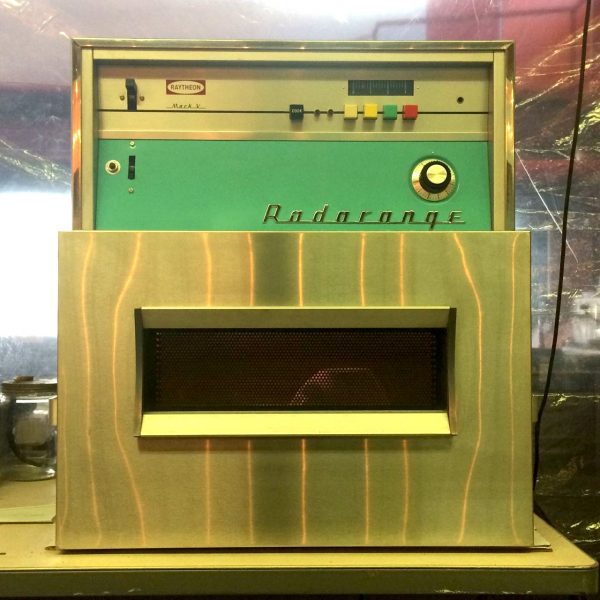
The microwave would take a long slow path to reaching consumers. The first commercially available designs in 1947 weighed over 700 lbs, were over 6 feet tall, and cost $5000 (about $40k today) . In 1971 only 1% of U.S. households had them. By 1986 it would rise to nearly 25%. Shown below is the Raytheon Mark V Microwave (1963) used mostly for commercial purposes. Note the four color button UI for different time settings.

[Excerpted, and revised, from Chapter 9 of The Myths of Innovation]

References:

How the Post-it Note Was Invented

[In 27 days my latest book, The Dance of the Possible: the mostly honest completely irreverent guide to creativity, launches. I’ll be counting down the days until then with the story of an interesting idea, fact or story related to the book – you can see the series here]

In 1968 Spencer Silver, with a PhD in organic chemistry, worked for 3M as a senior chemist. Among 3M’s most popular products at the time were different kinds of adhesives, and Silver worked on a project to create a new kind of stronger glue. Unfortunately his prototype was a failure: the glue was weak, too weak to be useful for anything. It was more of a sticky substance than a bonding glue. (No one knew it yet, but this substance contained an important discovery called microspheres, which would lead to a patent years later).

For many years Silver tried to find uses for this substance, but despite many experiments couldn’t find any. Most people would have given up, but he kept trying.  In 1973 he had a new boss, Geoff Nicholson, and Spencer pitched him on the idea of using his creation on bulletin boards and other surfaces to make them sticky (eliminating the need for pushpins). But the potential seemed limited.

Another 3M employee named Art Fry saw a lecture by Silver where he talked about this curious substance he’d created and his inability to find uses for it. Fry sang in his church choir and would make notes on little pieces of paper over his sheet music when he practiced, but they often fell off or got lost.  Fry and Silver worked together to create new prototypes for a paper with the weak glue that could be put on almost any surface. Fry suggested that Spencer’s design had it backwards: instead of making a surface sticky, the glue should be on the paper itself.

“We have a saying at 3M,” Dr. Nicholson said. “Every great new product is killed at least three times by managers.” (source). It was because of the support of Nicholson, Fry’s boss Bob Molenda, and the persistence of Spencer and Fry themselves, that they had the time to develop improved prototypes. Two more scientists, Roger Merrill and Henry Courtney, worked on inventing a coating for the paper that would keep the glue attached to it, rather than it being left behind on objects after the note was removed. The yellow color was chosen for convenience, according to Nicholson: it was what the lab next door had available, so they used it.

Prototypes of their work were popular in the 3M office, enough so that in 1977 executives approved a test release of a “Press ‘n Peel” product, as it was first called. A test release was required, in part, because the manufacturing machines would have to be redesigned to make this new product in large quantities, which may have contributed to internal resistance to the product. It seemed a very expensive proposition to build new production machines for a product that didn’t have, in the opinion of company veterans, high odds of success.

The response to the test release wasn’t positive – few people were interested in the product. Nicholson and others felt that the product wasn’t marketed well in this release, and that free samples needed to be given away so people could understand the concept. Finally in 1978 a second product release took place in Boise, with free samples, and it was a success. Soon the product was launched to the world in 1980 and is now one of the most popular office supply products in history.

Lessons:

  • You can’t predict what uses an idea will have, even if the idea is yours (“We never throw an idea away because you never know when someone else may need it” – Art Fry)
  • Spencer had to pitch his idea many times, in lectures and to his bosses, to obtain the attention it deserved
  • It can take years to develop an idea or invention into a meaningful concept
  • An idea, even a great one, needs to overcome organizational resistance
  • Rarely is there a lone inventor – most often a multitude of contributors are involved

Timeline:

  • 12 years from idea to successful product
  • 1968 – Silver’s “failed” glue prototype
  • 1973 – Silver pitched new boss Nicholson on spray/bulletin board concept
  • 1977 – “Press ‘n Peel” memo pad product in limited release, mixed response
  • 1978 – Rereleased in Boise, ID (called the “Boise Blitz”) with free samples – strong response
  • 1980 – National release of Post-it notes

References:

Why no one cared about the Wright brothers airplane

[In 28 days my latest book, The Dance of the Possible: the mostly honest completely irreverent guide to creativity, launches. I’m counting down until then with a story a day  – see the series here]

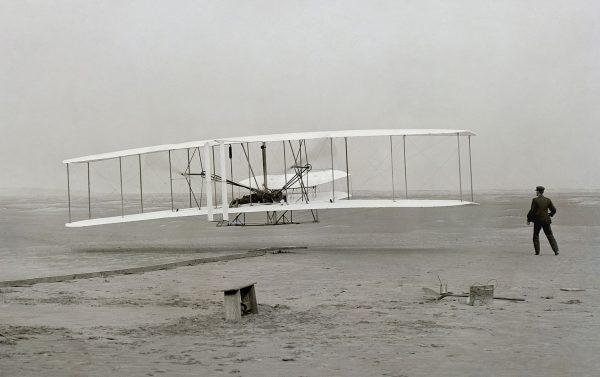
When the Wright brothers landed from their famous flight at Kitty Hawk on December 17, 1903 almost no one was there: just five people including a boy from the neighborhood. This is surprising to us in the present because in the nearly 114 years since that day airplanes have become central to modern life. But at the time airplanes were mostly a curiosity. Many other inventors over the centuries had attempted, and in some cases succeeded, at different variants of assisted and even powered flight. But the world shrugged at them all. “What problem does this solve?” was an excellent and largely unanswered question for these men and their machines.

Even the Wright brothers themselves weren’t entirely sure what powered flight could achieve. They passionately believed the invention would help end wars, as the power to see enemies from above would, in their thinking, eliminate the incentive to attack at all. Given the central role airplanes have played in modern warfare for decades this notion seems terribly naive, but inventors often are. The ability to create something doesn’t come with the ability to predict the future (although often often comes with enough hubris to make the inventor believe otherwise). Regardless, they faced a more pressing problem after their famous flight. Almost no one in the U.S. was interested in their creation for any purpose at all.

The Wright brothers had to go to Europe for a time to try and to sell their ideas, and it took many months before they found their first customers. They finally negotiated a contract with the U.S. government in 1907. It was the first military contract in aviation history. It took four years to get someone to pay for their airplane design.

What can we learn:

  • When you do something truly significant, the world may not understand or care (see Why The Best Idea Doesn’t Always Win). Selling an idea is often harder than coming up with one. (“Don’t worry about people stealing an idea. If it’s original, you will have to ram it down their throats.” – Howard Aiken)
  • It’s hard to predict how new ideas will be used, even for their inventors
  • Progress and change happens far slower than we think (and history helps remind us of this fact)
  • Asking “what problem does this solve?” is a powerful tool – but not having a clear answer does not mean the idea is useless (although it might be). It may just mean the use hasn’t been discovered yet. Working on new ideas is a dance with both the possible and the impossible.

The detailed invention story of the Wright brothers airplane is one of my favorites and among the most rewarding, as they patiently applied problem solving, research and invention approaches without any formal training. An inspiring, and well illustrated, read is How We Invented The Airplane by Orville Wright.

The Dance of the Possible

The Dance of the Possible is a short book that captures my best advice from years of work as a creativity expert in one fun, easy to read volume.

This short, fast paced, irreverent guide to creativity is for everyone who wants better ideas and to finish projects they inspire. In 21 short chapters you’ll discover a fresh way to understand creative thinking, how ideas work, plus insights from decades of study on both how to be more productive and creative at the same time.

The book’s launched on Wed March 15th. Right now you can:

Early praise for The Dance of the Possible:

“You’ll find a lot to steal from this short, inspiring guide to being creative. Made me want to get up and make stuff!” – Austin Kleon, author of How To Steal Like An Artist

“A fun, funny, no-BS guide to finding new ideas and finishing them. Instantly useful.” — Ramez Naam, author of the Nexus Trilogy

“Concisely debunks all kinds of misconceptions about the creative process in a book that’s no-nonsense, fun, and inspiring.” — Mason Currey, author of Daily Rituals: How Artists Work

“This book will undoubtedly increase your abilities to invent, innovate, inspire, and make things that matter. It’s fun, it’s funny, and it’s phenomenally effective.” – Jane McGonigal, author of the New York Times bestsellers Reality is Broken and SuperBetter

“Highly recommended for anyone whose employment just might depend on the quality of their next idea.” – Todd Henry, author of The Accidental Creative

“Creativity is the nature of the mind. It is our birthright and our gift. The Dance of the Possible, beautifully, reminds us of how to open it.” – Sunni Brown, author of Gamestorming and The Doodle Revolution

“A fun read and a helpful book! Berkun demystifies creativity in work and play with nuggets of truth and common sense.”
Dan Boyarksi, Professor, School of Design, Carnegie Mellon University

“This new nugget of genius from Scott is the best thing I’ve read about creativity in a long time.” – Dan Roam, author of The Back of The Napkin and Draw To Win

“This short, irreverent-yet-authoritative book from Scott will set you on the right path to get inspired and take action on what you create.” – Chris Guillebeau, NYT bestselling author of The $100 Startup and host of Side Hustle School

“…makes the font of creativity something that is right at your door, offering you a cup and inviting you to drink every day.” – Andrew McMasters, Founder and Artistic Director, Jet City Improv

“A spirited and tangibly useful guide to actually getting art done — memorably clear, mercifully artspeak-free, and filled with pithy nuggets of real-world wisdom.”   — Ted Orland, co-author of Art & Fear.

“The best short book on creativity yet! Playful, irreverent, insightful, exciting! Full of good advice delivered by example rather than description. Get on with it, Berkun advises, and expeditiously gets you on your way!” – Bob Root-Bernstein, co-author of Sparks of Genius, Professor of Physiology, Michigan State University

“Decades of creative experience distilled into an efficient little book you can finish on a plane ride.” – Kirby Ferguson, filmmaker, Everything is a Remix

“…demystifies the creative process and makes it easily accessible to anyone. If you’re looking for the quickest route from stuck to creative spark, this is the book for you.” – Dave Gray, author of Liminal Thinking and The Connected Company

“Many ambitious young folks think all they need is a great idea – now I tell them what they need is to read The Dance of the Possible.” – David Edery, game designer and CEO of SpryFox Games

“Berkun brings practical bite-sized brilliance. My problem was every two pages I put it down, inspired to go make something.” – Steve Ball, Musician / Composer

“Scott is masterful at asking questions that turns us sideways, keeps us engaged with his light-hearted voice and clever format, while ironically inspiring us to jump up and DO. This book would’ve saved me almost two decades of bumping along, trying to figure this out for myself.” – Kyle Kesterson, Founder & Chief Storyteller – ‎Campfire

You can order the book on kindle or in paperback. And if you’re on my mailing list you’ll get a digital copy of the book for free before the rest of the world.