How to run a bug bash

Running a bug bash is a dirty secret of software development. You won’t read about them in software engineering classes, or in agile method workshops. But some managers, when overwhelmed with undocumented bugs and not sure what else to do, demand the whole team stop what they’re doing and get as many bugs into the bug database as possible. This is what’s known as a bug bash, and often they’re a waste of time.

It’s true that a proper QA effort, or test-driven development, minimizes the need for this sort of thing, but few software organizations truly qualify. Hell, many so called “first class” organizations don’t have any testers, or a quality assurance plan at all. I bet bug bashes are one of the most common QA techniques used in the world.

And they can be useful – but the most common mistake is doing them by half. A half-assed bug bash sends the message software quality is lip-service. But doing it the right way can turn a project around, raise morale and sharpen a team’s ability to find and manage issues.

How to run a successful bug bash:

  • Don’t create panic. If you say “Tomorrow! Everyone find bugs! Aaaah!” You are creating a panic and look like an idiot. You should know a week or more in advance that the bug counts are soft, or the database needs scrubbing, and line up leads and key players to support the effort.
  • Freeze the build. You can not do a bug bash on a moving target: you invalidate repro cases and bug findings. Pick a build, freeze it, and make sure no one, NO ONE touches the live codebase during the bugbash. This should go without saying, but you never know. If it’s your first team wide bugbash make sure the entire programming team understands this basic rule.
  • Show what good bug reports look like. Remind everyone crappy bug reports create extra work. Provide two bug report examples: one good, one bad. In the good example show well written description, clear repro steps, and a search for duplicate bugs. In the bad, show incomprehensible descriptions, impossible repro steps, etc. If you don’t provide examples, don’t expect people to magically know what you’re looking for. Finding 1000 crappy bugs that need to be heavily cleaned up is a waste of everyone’s time.
  • Have an area or type of bug to focus on . Saying “find bugs” is a shot in the dark. It shows you have no clue what’s going on in your project. Think through what the weakest areas are, or what types of bugs you are most afraid of, and designate them the primary goals of the bug bash. Or offer bonus points (e.g. bugs in area 6 are worth x2) for people who find the specific type of bug most valuable to you.
  • Clear the afternoon from everyone’s schedule. A bug bash should be an entire team activity and a half-day is the perfect amount of time. Everyone should be working on the same goal: getting good data into the bug database, and getting that database in shape. If it’s voluntary, or only half the team is asked to do it, the bash will fail. People will smell you’re not serious about the effort, and will contribute accordingly. Get permission to reschedule all team meetings for that afternoon to later in the week, and send out a new meeting invite to the team for the entire bug bash time slot. Include details (see below) on where bug bash HQ is, what the prizes are, etc.
  • Get support from big shots. Brad Silverberg, my VP on Internet Explorer 4.0, used to file bug reports regularly. When bug bashes started he’d set the tone: everyone gets involved. With the support of leaders it sets the tone of how important the activity is, and eliminates the BS excuses people find not to participate (“If Fred, our best programmer is doing it, I should be doing it too”). Find the key players on your team, either key leaders or the star programmers, and get them to help promote and contribute.
  • Have a bug bash HQ. Finding bugs can be a social activity: have a bug bash headquarters. Grab a conference room, order pizza and beer, and invite people with laptops to hang out and find bugs together. This invites people to help each other find repro-cases, share knowledge and bug database tricks, makes keeping a scoreboard easy, and makes the bug bash a proper morale event. A case of beer and few pizzas costs $60. Well worth it.
  • Keep score and have real prizes. Geeks are competitive. Use this to your advantage. Any bug database allows queries for open bugs by date: Get this up on a website or hallway monitor and show it in real time. Buy some nerf weapons, dinner gift certificates, or even some X-box video games, and have them visible at HQ – give them away as prizes, or set up a betting pool: $10 per person, and the winner gets the pot. You can get fancy and have special prizes for most twisted bug, the bug least likely to ever get fixed, etc.
  • Create rival teams. If you are totally poor, use ego prizes. Have the designers challenge the programmers, or the marketing team challenge the management team. Throw down: “I’ll bet the whole marketing team dinner at Ruth Chris’ my 3 reports can find more bugs than your whole team can”. If you don’t have cash, bet embarrassment: loser shaves their heads, has to dress in costume the next day, has to wash the opponents cars, etc. Get two sets of people who have some built in animosity or rivalry, especially if it’s well known, to openly challenge each other. This rivalry will draw more people in, if only to follow along. Do this once and you’ll have a tradition to build on for the next bug bash.

New video: How to make things happen

When Making things happen came out in March, I did a few talks here and there to help promote the new edition, including a stop at a little place called Microsoft, in Redmond, WA. They videotaped the talk and it’s now available online.

You need to be running IE, or using the IE plugin for firefox, for the video to play. Sadly it appears to run on Windows only (I know, I know – its not my choice):

Title: How to make things happen

Description: What are the secret tactics used by successful project managers? How can people in any role, from development to management to design, benefit from their playbook?This fun, fast-paced, and interactive talk, loosely based on the bestseller Making Things Happen (formerly known as The Art of Project Management), explains how to make good things happen, and how to triumph over powerful people who are annoying and frustrating. Bring your toughest questions and situations for the Q and A, where Scott gives away signed copies of the brand-new, updated edition of Making Things Happen.

Watch the video for How to make things happen

How to start writing a book

Every artist was first an amateur. ~ Ralph Waldo Emerson

I get hundreds of comments and emails in response to the post on how to write a book. Here’s another interesting, and life-grounding, question from the mailbag:

I found your website hand thought it was awesome. I watched your videos and decided I could use some advice from you.

My house burnt down 3 weeks ago in Burnsville, Minnesota. I lost a 38 foot RV, a 69 Plymouth Fury Convertible, and monster truck and trailer in the driveway and my 16 years old sons car he worked on so hard and never got to drive. I also lost 5 animals in the fire and that really hurts. I still have my 3 children ages 23, 16 and a 10 year old daughter who is having night mares with all this life changing overnight experience. Guess what? I want to write a book about my life and how it changed so quickly. I am very grateful we are all alive and ok. Like everyone else I dont know where to start. I am living my worst night mare in a hotel gong on a month. We have nothing but the cloths we were wearing that day. Any advice would be greatly appreciated. Please contact me.

Very sorry to hear about your loss. I do hope there are local government agencies or non-profits that can offer you some assistance. Books aside, I do wish you and your family well.

On starting: there is no single easy way. Everyone is different. There are tricks I list in this essay on writing hacks, but some or one will work for you. The truth is how you start doesn’t matter, but if you wait for a perfect way you’ll never get started. If that essay doesn’t help, here’s additional advice:

  • Plan to write every day. Writing a book is a marathon. It’s more important than you work a little every day, than how much you work on any particular day. Are you good with self discipline and forming new habits? If yes, great. If not, that is likely the real skill you need to learn.
  • Plan to come back. One trick is to remember that the real work in writing is editing, something that only begins when you finish a first draft. I plan to come back later and revise, cut, rewrite and do all kinds of work for the second draft. The “writing” part is just the beginning. Having faith in the next draft has a freeing effect. There’s no pressure to get things right, or even to make them good, on the first draft.
  • Take a course or find a coach. There any many teachers and experts willing to help you along. Start with Jane Friedman and her recommendations.
  • Go chronological. In your case you’re writing about things that have happened, or are happening to you. Great. Pick a date, say a week before the fire, and write about what happened every day from them to now. It could be as simple as two or three facts per day, or memories per day, or your recollection of your thoughts on those days, whatever you like. But anchor on time as the spine of your writing. It creates an easy way to divide up your memories, and to trigger thoughts or recollections. You then might choose to go to your family and friends and get their stories and recollections on every day, giving you even more material to work from.
  • Draft an outline. An outline can be one page long or fifty. It depends on how much detail you feel you need to get going. If it’s your first book, I’d strongly recommend writing a two page outline that covers, at a high level, all of the major events or points you want the book to cover. It’s a good test: if you can’t write two pages, you probably won’t be able to write a book. If you can write a two page outline, put it aside for a day or two and then come back and re-read the whole thing. Is there a better order to explain events? If so revise. And then pick one of the chapters and get to work. Repeat.
  • Keep a notebook with you. Have a place to write down ideas and thoughts about your experience and keep it with you all the time. Your rule should be whenever a thought crosses your mind, no matter how strange or personal, you write it down. Worry later if its good or interesting, but in the moment, commit yourself to writing something down. I have piles of old notebooks, and go through one every few weeks.
  • Read books like the one you want to write. Learn from other writers by reading their work. For every “how can I?” question you have go find a book and see how a successful writer solved the problem. If your book is a memoir, many great writers have written books about their personal experience with tough times. Check out Joan Didion’s The year of magical thinking, about her experience with having two loved ones become seriously ill at the same time. It can help to see how other writers have tackled the same type of writing you’re going through.
  • Write every day. Even if it’s just for 5 minutes, even if it’s just a sentence or a few words, sit down and write every single day. You have to get used to how it feels to sit there and that only happens if you put your ass in the chair every single day. Find a slot in your schedule that you can protect (early mornings or late nights often work) and ask family to respect that time.
  • Have a plan for staying motivated. A book will take 500-1000 hours of work to write. That sounds scary, but most people watch 1000 hours a TV every year (4 hours a day).Writing is straightforward to do, but you have to keep showing up. Think about your reasons for staying motivated. Create a writing calendar where you can leave a note, or a mark, every time you sit down to work. This will help get some positive feedback every time you put in some effort, even if you’re not very productive on a given day. Your output from any writing session doesn’t matter much provided you continuing to work on it day after day.
  • Work towards a complete first draft. You can only write one draft at a time, so focus on the one in front of you. Don’t worry about how many drafts you’ll need. A draft needs to be complete enough that someone can read it and give useful feedback to you. If an entire draft is too, work towards having a complete chapter. Then two. Then more. Ask for feedback from people whose opinions you trust. And with that feedback you’ll be able to decide how to revise for your next draft.

I hope that helps get you started. Best wishes.

If you’re thinking about how to publish:

Have a question for the mailbag? Leave a comment or contact me here.

A million dollars for your best idea

Google, as part of their 10 year anniversary, is launching Project 10100, offering millions of dollars to the best ideas they can find for helping people.

From their FAQ:

What is Project 10100? Project 10100 (pronounced “Project 10 to the 100th”) is a call for ideas to change the world, in the hope of helping as many people as possible.

Why is Google doing this? The short answer is that we think helping people is a good thing, and empowering people to help others is an even better thing. Here’s the long answer.

How many ideas are you funding?
We have committed $10 million to fund up to five ideas selected by our advisory board.

As best I can tell you don’t need to execute the idea or even have a plan. They are paying for the idea itself. A creative thinkers dream! Except of course you likely lose control over the idea after you win your cash.

Read the full FAQ here. Deadline is October 20th.

(Seattle) InfoCamp 2008 this weekend

Hadn’t heard of this before, but there’s a design unconference here in Seattle this weekend: InfoCamp 2008.

$50 gets you in for two days of DIY sessions on information architecture, user-centered design, librarianship, and information management. According to their description, It features an egalitarian, community-driven format in which presentations are designed and delivered by attendees.

Their website has a wiki, full schedule, blog and info on registration. If you’ve never been to an unconference before and work in design, check it out.

If you’re thinking about running a session at an unconference, check this out.

How hard to immigrate into the U.S? Awesome flowchart

I can’t say how accurate this thing is, but it’s both a great piece of design (By Terry Colon, formerly of Suck), and a polarizing commentary on immigration policy: this will either anger you or make you happy. I know for sure my great grandparents would never have made it through this – Instead of being here writing this, I, like they were, would probably be a peasant farmer somewhere in Eastern Europe.

And here’s the blog post it comes from with it’s own comment thread (Hat tip, metafilter)

What I’d like to see are: 1) similar flowcharts for other first world countries. 2) Similar flowcharts for 50, 100, and 150 years ago in the U.S.

Microsoft & the social network wars

Interesting analysis by fellow Harvard Business blogger John Sviokla about Microsoft’s missed opportunity to enter the social network game:

Microsoft’s Outlook may be the world’s Rolodex, but they have not figured out how to link up all the latent connections that sit inside our Outlook address books. Put another way, they have the ends of the network, but don’t know how to tie them together!

In your email is a latent network of most of the people you know, and how often you talk with them. The Outlook add on – not made by Microsoft – called Xobni (pronounced ZOBNEE, and named for Inbox spelled backwards) looks through all the mail on your machine and figures out who knows whom by who is copied on which emails. In other words, your emails naturally contain your social network. It would be easy for Microsoft to simply ask your permission to contact the people in your email list, and Outlook contact database, and ask them if they were willing to join your Microsoft social network.

(Sviokla’s full post)

There is a ton of social network data in our cell phones (who do you call/text most often? Talk longest with?) and email applications, and a simple app could mine that data and build, or at least enhance, networks from it.

The problem is that for many people Outlook is no longer the primary contact list. Anyone using Linked-in or Facebook depends on those sources as virtual contact lists. Facebook wisely offers to import contacts from many sources when you create your account.

The surprising thing to me is that there isn’t a wikipedia, or craigslist, of social networks. A free, non-corporate, social network that protects it’s users by charter against the pressures of corporate raiding of personal social information.

What wall street should be required to do

I don’t write much about politics and the economy, but the recent bailout makes that impossible. Best thing I’ve read so far, pragmatically speaking is this list of suggestions from Robert Reich:

My five nominees:

1. The government (i.e. taxpayers) gets an equity stake in every Wall Street financial company proportional to the amount of bad debt that company shoves onto the public. So when and if Wall Street shares rise, taxpayers are rewarded for accepting so much risk.

2. Wall Street executives and directors of Wall Street firms relinquish their current stock options and this year’s other forms of compensation, and agree to future compensation linked to a rolling five-year average of firm profitability. Why should taxpayers feather their already amply-feathered nests?

Read the full excellent, and thought provoking, post here.

How to free your inhibitions

Here’s a recent item from the mailbag/comment bag:

How do i free myself, kill my inhibitions and break away from any kind of mental consciousness i keep facing every time i want to do something really badly. I’m simply afraid, man. Afraid, i might hurt somebody or offend someone who i care for, might come across as selfish. Your talks are fun and exciting and an adventure in itself. Now, please help me in figuring out a way to just free myself from my other self. The lamb leads the lion in me so to speak. How do i reverse that relationship? I eagerly await your reply. Thanks so much man. You’re the Man!

I’m not a self help guru, but that might be a good thing here as I don’t have a nice, kind, warm fuzzy fluffy answer for you.


I recently went to a bachelor party at a rented house on a lake in Texas. On top of the boat dock, 20 feet off the ground was a swing: you grabbed the trapeze handle, swung out over the lake, and dropped into the water. Sounds cool, but it looked terrifying. Something about the angle of the water from that vantage point made it look unnatural. The result? A gaggle of 30-something year old men, standing on the edge, trying to build up the guts to jump.

One guy had done it. And when it was my turn to try I knew I had to turn off my brain in order to do it. Switch it right off – and decide before I put my hands on the trapeze that I was going to just jump without thinking. And that’s what happened. I jumped, and it was not nearly as scary doing it as it was thinking about doing it.

Two of my friends however spent the next hour, literally 60 minutes, standing on that ledge, the hot Texas sun beating down, looking down, trying different ways to think through the problem. A strategy set up to fail as this was not about thinking. While they never jumped, it was impressive to watch them fight a battle in their own minds for that long.

For some things in life there is no planning. No way to rationalize. It is either done, or not done. And the trap is the more you think about them, the larger the fear of doing them becomes. The trick is to be able to turn off that voice and operate without it. Create courage by denying the rational mind. And its a kind of self-knowledge to recognize when shutting off your mind is the only way to achieve what you want to achieve.

In your case things are perhaps easier. You can test your fear. Ask your friend if they’d be hurt if you wrote a book. Ask the people you care for if they can support you in trying to live your life differently, or to take a certain risk. GO AND ASK. If you never ask then the fault is yours. If you do ask for support and don’t get it from your closest friends, then you need to find new close friends. Ones who want to help you grow and be happy. Either way, in taking action you win. But in being passive and worrying, complaining, imagining, you make your own mind a trap, like my friends by the ledge.

Got a question you want answered? Ask Berkun or put it in the mailbag.

Need a new web host – recommendations?

I’ve finally had enough of dealing with dreamhost. Love their features, but man, does stuff go down often. And today, not for the first time, all incoming email is bouncing. Just plain unacceptable.

I’m looking for a new webhost and could use recommendations. It doesn’t seem there is a decent source of web host reviews, and even the best i’ve found is thin – so I’ll hoping for advice from you folks, as you actually might care to see this site nice, stable and healthy.

My needs:

– I’m willing to pay more for reliability and decent support.
– WordPress is my life. Prefer hosts that understand WP, or offers it by default.
– Need medium level bandwidth support.
– Easy non-geek management a plus. I’m smart, but want to spend as little time in shell/Unix as possible.

I’d also love to find a website transfer service that, for a fee, moves all of my domains and stuff from one host to another. Am I in fantasy land?

Suggestions much appreciated – Cheers.

How to work better in ten easy steps

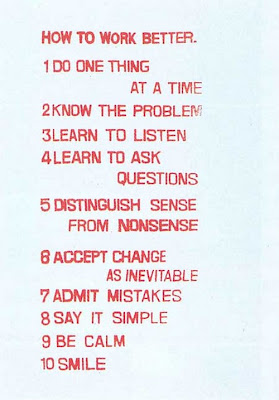
This bit of pithy advice is floating around the web. It’s so nice, tight and simple, much more useful than many of the self-helpy business books I’ve seen in the last few years. I mean, what percentage of your co-workers do even half of what’s on this list?

Found it here, but this seems to be the original source (Much like Corita Kent’s list of creative rules, there are many unattributed postings).

  1. Do one thing at a time
  2. Know the problem
  3. Learn to listen
  4. Learn to ask questions
  5. Distinguish sense from nonsense
  6. Accept change as inevitable
  7. Admit mistakes
  8. Say it simple
  9. Be calm
  10. Smile

And the winner of the invention contest is…

A few weeks ago I ran a little creative contest on inventions people would like to see. The best of the bunch, although there were many was from Carlos:

Ctrl+Zetit: an invention to undo things in life that just happened to you. Broke an expensive jar at your inlaws’s house? No problem… just Ctrl+Zetit!

Not a big fan of the name, but I sure would love this. I remember back at CMU, after an all nighter working on a programming project, going into the elevator, hiting the wrong floor and looking for the undo command. Carlos’ idea made me think of that moment, and a signed copy of Making things happen is on its way to him.

Thanks for all the great ideas – made my day!

How to diagnose creative failures in organizations

One of the first things I do when asked to help organizations be more creative is diagnose where failures happen. The word innovation is so vague that even executives and groups committed to it don’t understand what to look for or where the problems are, if there are any at all. The best definition for innovation is: significant positive change. It’s impossible to get significant positive change in one fell swoop. Even the most brilliant idea has to work it’s way through an organization and there’s no guarantee that good ideas can survive.

As a fundamental rule, the more gates and gatekeepers you have, the harder it is for even great ideas to make it to customers. You can’t have conservative management and innovation at the same time. Innovation demands risk. It’s no surprise entrepreneurs drive many of the new ideas in the world, since they have very few people (with the authority to kill ideas). In most workplaces the reason not much progress happens has far more to do with politics, bureaucracy and culture, all things born of management, than any lack of innate creativity among employees.

What you need to do is follow the life of ideas in your organization. When a new idea is suggested what is the path it has to follow to make it to customers? The idea has to survive from it’s birth in someone’s mind, through meetings and proposals, through prototyping, through the organizational bureaucracy, through budget battles, and finally make it out into the world to customers. Where is the bottleneck? Where do most ideas die? To understand this life you need to make a map of the lifecycle.

The idea lifecycle

Every organization is different and you can make your own list of gates, but here is a simple one to work from. Ask yourself where your own ideas, ideas from your team, or ideas anywhere in your organization tend to die. That’s the point where work needs to be done to improve the number of ideas that survive to the next stage.

  1. Idea
  2. Pitch
  3. Proof of concept
  4. Prototype
  5. Plan
  6. Commitment of resources to the plan
  7. Navigation of the bureaucracy
  8. Execution
  9. Release / Launch

In many organizations the bottleneck is surprisingly at the pitch. Despite all of the rhetoric, the culture is negative and kills new ideas as they’re born in meetings and conversations. And the skillset of pitching is underdeveloped. There’s no reason to worry about breakthroughs and transformations if people are both bad at pitching and leaders are bad at listening to them. If people are afraid to propose ideas, the problem isn’t creativity, it’s stifling management.

Innovation also depends on experimentation. To do something new demands taking risks somewhere in the organization, even if it’s just at the cost of a few hours of an employee’s time. Healthy organizations have many experimental ideas in play, giving people room to explore whether an ideas has merit or not before it’s rejected (or accepted). 

If most new ideas fail at the prototyping stage, then you likely need to hire different people. It’s product designers who have the strongest training for converting good ideas into good plans. Even if  your organization isn’t focused on design, their skillset for developing ideas is likely the key deficit you need to fill to move more ideas further down the pipeline.

Once you’ve identified where the creative bottleneck is, you can ask questions about how to improve the number and quality of ideas that make it through that step. Perhaps different people need to be the gatekeeper. Or the size and shape of the gates need to change.

And of course each idea and project are different. There could be lessons to be learned that are purely about the way the project was developed, rather than a fundamental problem with the organization. Project debriefs or postmortems should be common enough that people with new ideas can look back on previous creative projects and read about what the people who worked on it would have done differently.

If you liked this, checkout the free summary of the bestseller, The Myths of Innovation.

[Note: Post updated 3/4/2014]

Questions on Innovation from Microsoft

Had a nice crowd of about 150, plus another 300 online at Microsoft today. The talk will be posted soon on the Microsoft research site, but in the meantime here are some of the good questions I was asked.

If you were there and recall others, or have some to add based on the Myths of Innovation talk (youtube version here for non-microsofties), fire away:

  • How do you rationalize your statement that there is no single method, with your advice for managers (delegate) at the end of your talk?
  • In your Luddite example you pointed out how hard it is to make change happen. Any advice for innovators on working around this challenge?
  • Is Microsoft an immitiator? Given your experience here and elsewhere, how do you view the perception of MSFT and other companies as innovators or immitators?
  • What is the role of culture in making innovation happens? Are there really as many recluses and lone geniuses as we think?

I’ll update this with my answers shortly.

Speaking in Chicago, Sept 22nd, Free & Public

I’ll be doing a lunch talk at DePaul University on Monday Sept 22nd, 11:45am. Thanks to my host, Professor Lisa Gundry, the talk will be open to the public. All that’s required is an RSVP by email.

What: Talk about Myths of Innovation + Q&A
When: Monday, September 22, 2008, 11:45-1:00
Where: DePaul Center (DPC) 11013 – Loop Campus directions.
Cost: Free!
RSVP: email creativity_center@depaul.edu

Description: How do you know whether a hot technology will succeed or fail? Or where the next big idea will come from? The best answers come not from the popular myths we tell about innovation, but instead from time-tested truths that explain how we’ve made it this far. These topics and more will be covered in this fun, interactive talk based on the bestselling book, The Myths of Innovation. Bring your toughest questions on creative thinking, innovation and management!

Hope to see you there – and please help spread the word.