Please Don’t Be Generic (When sending LinkedIn requests)

I believe in first impressions, especially if you’re asking someone else for something. When you make a connection to another person, even on the interwebs, please take 60 seconds to say something personal about why you’re making the connection.

If you’re not willing to take 60 seconds to write something personal, and explain why you want to connect, why would you expect them to say yes? If they’re important enough to you to ask for something, match that with putting in a moment of effort. Otherwise you’re the equivalent of a stranger running up to someone on the street and asking to shake their hands, screaming “You’re someone I trust!” as you do it.

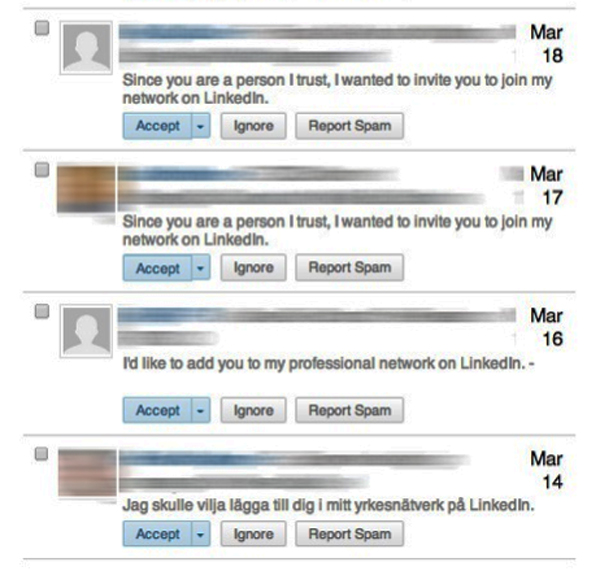
Here is what my LinkedIn inbox always looks like (see below). It’s often filled with generic requests from people whose names I don’t recognize, where the request tells me nothing about who they are, how they know of me or why we should connect. It’s a wasteland.

Linked1

That last guy didn’t even get the language right as I only speak English.

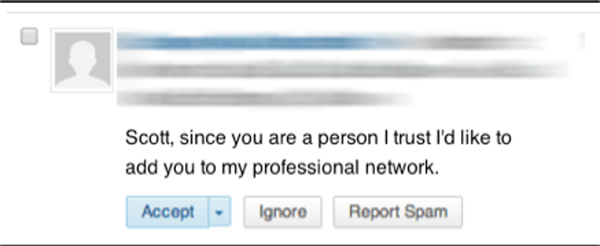
The generic messages LinkedIn offers should be avoided. How could I be a person you trust if we’ve never met? And even if you trust me, that’s not the important part on my end: why should I trust you or find you worthy to connect with? It’d be far better to explain how you met the other person, why you’re a fan of their work, or how on earth you even know who the hell they are.

linked2

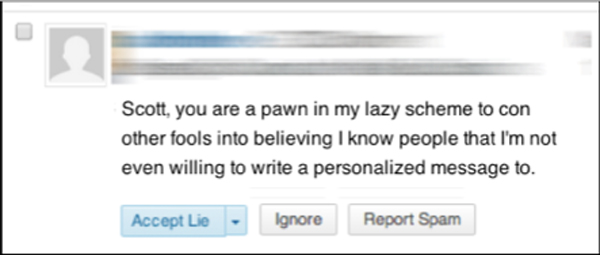
When I see these generic requests (above), I translate it to mean the following (below):

linked3

Advice:

  • Take 60 seconds to say something personal and meaningful
  • If you can’t, don’t bother sending the request
  • Unless you’re sure the person knows your name name well enough that it’s meaningful to them

[This post is excerpted from How Events And Conferences Should End]

Noah: movie review (Spoiler Free)

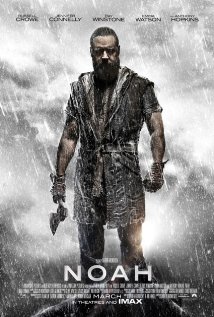
noahI’m fascinated by religious history and love movies, so it’s no surprise I’ve seen many films with religious themes. Even when I’m familiar with the texts they refer to, I often go back to reread and compare how the filmmakers handled the many challenges of trying to make a narrative movie about texts written for very different purposes. Most bible movies fall under the pressure to convert these stories into modern forms. The Ten Commandments, as over the top as it can be, is one of the best of these attempts. While The Bible, starting George C. Scott, Richard Burton and Elizabeth Taylor is perhaps the worst (though its coverage of the tower of Babel is the only one I’ve ever seen on film).

Noah (2014) is one of the stranger movies about a biblical story you’re ever going to see. It is an interesting, but also frustrating film. I’d recommend it primarily if you are interested in how a talented artist used such an old and familiar story as the framework for many bold and unexpected turns. Purely as a telling of the tale from the bible it doesn’t work as well, and it’s also choppy as a hero driven disaster film, which is perhaps the simplest way to frame the narrative of the story. There are anachronisms everywhere, so many that I lost count (everyone is white, they speak with a British accent, they have finely tailored clothes, and on it goes). But this was ok. From the beginning of the film it’s made clear this is an artist at work. The rules he is following are his own and I found this liberating and challenging.

The passages in the bible about Noah are barely a few pages, and much of them are about the ridiculous plans God gives Noah to build the ark. I always find engineering instructions in religious texts to be comical, as I’m not sure who they’re trying to convince that anyone would build anything the way they describe even in ancient times (engineers were clearly not included in the meetings about how to tell these stories). It often reminds me of the techno-babble in Star Trek, designed as theatrics mostly to impress the uninitiated.

Director Aronofsky takes full advantage of how much is missing from the Noah story, in some cases for better and others for worse. It’s a beautiful film. There are gorgeous montages, wondrous landscapes, and finely crafted recreations of bits of the Genesis story (although interpreted in ways surprising to many Christians, who forget that the Old Testament was written by Jews, as a Jewish text, with their own interpretations which were favored by these filmmakers). The pacing of the story is odd, almost clumsy, with a heavy reliance on Hollywood cliches. This was surprising given Aronofsky‘s body of work, where he has always placed his vision, however flawed, above falling into these kinds of empty patterns. My favorite speech of the film is uttered by the bad guy (a character absent from the Genesis story itself), and it never gets the resonance it should simply because of whose mouth it comes from.

Making films about the Bible always upsets someone, as most religious factions are continually shocked to learn all of the other factions interpret these texts differently than they do (cue The People’s Front of Judea). I fail to see why films are expected to follow their source material precisely, religious or otherwise. Film is a different medium and trying to replicate a book in film is a mistake (part of why so many movies about the bible are so bad: they’re overly reverent for the trivia). It’s the spirit of the material, the themes and messages, that are most important to capture. This version of Noah has been criticized for breaking with details from the story in the bible. I didn’t mind most of these departures, I just couldn’t decide why some of these choices were made (e.g. In Genesis all of Noah’s boys bring their wives with them, but in the movie this is not the case). Theses departures often muddied the messages and questions, rather than clarifying or strengthening them.

The film is well acted. The performances are good. There are stunning, truly powerful visual moments. And even the hypocrisy of God’s instructions and behavior, a fundamental theme of the Old Testament, is made clear at times. But the muddy screenplay fails these contributions. This makes it tough to recommend the movie generally. If you like Aronofsky, the Bible, challenging films, or films with religious or philosophical themes, then go see it.

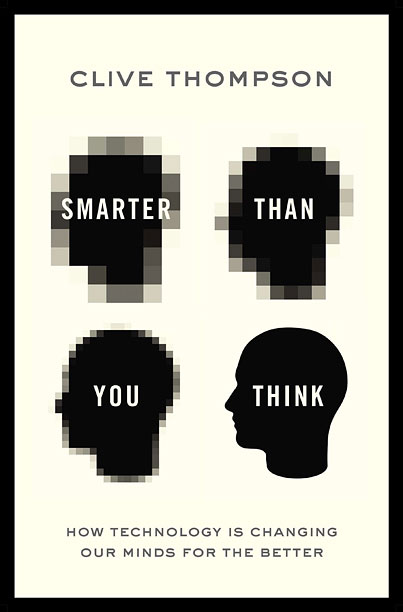
Book Review: Smarter Than You Think

9781594204456B.JPG

It’s wise to read books with points of view you don’t share. It’s the only way you get exposed to ideas with the power to change your mind. For a long time I’ve been a techno-neutralist. I’m not convinced technology is good or bad, it depends. I know from history how many unintended consequences our inventions have, consequences impossible to predict or prevent.

I read Smarter Than You Think: How Technology is Changing Our Minds For The Better with many doubts in mind. I certainly didn’t buy the premise as stated, but I would give it a run and see where it went. Clive Thompson writes well and thoughtfully in this book. He chose interesting stories to cover. Many of them were new to me and the way he framed them was interesting. He raised good questions I was glad to consider. I took a good number notes which is a strong indicator for me on how engaged I am in reading.

Where I struggled was with the false dichotomy of seeing technology as either good or bad. Too much depends on who you are and what your station in life is. If a new technology takes away your profession (and your home), you feel quite differently than the person whose life is made more convenient by that change. And on the scale of humanity, we’ve been poor at predicting where technological bets lead us. Gas powered automobiles seemed great news in 1945, less so in 2014. DDT was sprayed on people for years, until we learned its dangerous effects if misused. This is why highly polarized books on both sides are often underwhelming. Technology helps and hurts us at the same time, depending on the particulars of what happens and how we choose to use them. Cars bring pollution, phones bring distraction, etc. Technology always has two sides, and you are on one or the other, or a simultaneous combination of both, depending on your circumstances.

Where I struggled with the book was, as expected, the underlying premise. I was never convinced his stories supported it. Most of the stories are about very smart people who are perhaps made smarter by using a technology. These are exceptional people. Gordon Bell’s MyLifeBits project, where he has recorded all audio, video, and images of his life in a searchable database, is one story. Bell is no ordinary man, currently a research emeretus at Microsoft and a winner of the National Medal of Technology. Google Glass is also examined in the story of Thad Starner, but he’s exceptional too, as he’s the director of the Contextual Computing Group at Georgia Tech. Their minds were pretty damn sharp to begin with, challenging the question at the heart of the book: can a technology make anyone smarter who isn’t already smart? Thompson doesn’t say.

The book also avoids defining intelligence or what smart means, which was fine as the book was entertaining without digressions into definitions. But to seriously answer the central premise we need a definition to work. I prefer Gardner’s 9 part definition:

  • Musical–rhythmic and harmonic
  • Visual–spatial
  • Verbal–linguistic
  • Logical–mathematical
  • Bodily–kinesthetic
  • Interpersonal
  • Intrapersonal
  • Naturalistic
  • Existential

With a list like this we have a tool for examining what technologies do for intelligence. Without this list, we tend to bias towards the kinds of intelligence computers are good at as suggested by the cover design (recalling data, storing data) and discounting the ones technology is bad at (interpersonal, naturalistic, intrapersonal, existential). Thompson makes excellent points about kinds of intelligence where computers do wonderful things to help us. But he discounts the importance of the many kinds of intelligence that technology doesn’t help with at all. Things like picking spouses, choosing careers, finding fulfillment, being a good friend and deciding what best to do with our time on earth. Some of this loosely fits into Emotional Intelligence or into Gardner’s list of types of intelligence. A fun follow up to Smarter Than You Think could be to explore, for each type, how technology helps or doesn’t.

My biggest questions run towards the distinction between smarts and wisdom, and the book avoids going down that path. This was fine, but it was also my point of departure. The most important problems we have as a species aren’t problems of intelligence: they’re problems of wisdom, self-awareness, collaboration, and compassion, all things generally discounted since they’re harder to measure and harder to sell technology to solve (See Software Is Not Epic). Productivity is always the promised land in most kinds of tech-centric marketing – which is telling, as productivity is a very corporate, logical view of life. “I was productive today” – but what did you produce? Does what you did have meaning? Were you productive in a way that made your life, or life for other people, better? Did it connect you to other people you care about? And the list of deeper desires technology can’t directly contribute to or directly help us answer goes on.

How Events & Conferences Should End

Yesterday I gave the closing talk, How To Champion Ideas, at An Event Apart Seattle (If you saw me at AEA Boston, those slides are here) . It was a new talk, requested by organizers Marci Eversole, Jeffrey Zeldman & Toby Malina. From their observations and attendee feedback they knew one big challenge for all events is how to help attendees bring ideas with them back to work. As an experiment, they asked me to do a talk on this as part of the event itself. I thought it was great that both they were thinking about this issue and they were willing to do an experiment. I wish more organizers were as thoughtful and as brave.

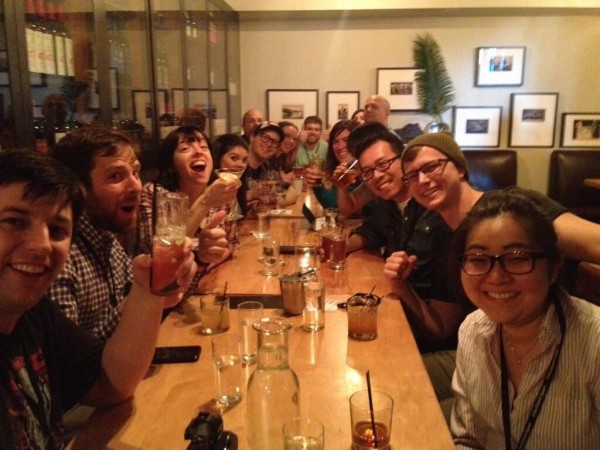
One primary observation: events should end with a happy hour. Or perhaps, like Webstock, with an after party at the venue. Most events end as soon as the last speaker finishes speaking. It’s a cliff of an experience: all of sudden there’s nothing. Why not invite people out for an informal social gathering, where they get one last chance to connect, share stories, and talk about highlights from the event, now that it’s over? As an experiment I invited everyone out to a drink after my talk, and the result was great. About 45 people joined me, and we took over most of Black Bottle.

I discovered that most people want this, but are afraid to take the social risk of trying to organize. It’s exactly the kind of thing an event, or the last speaker, can facilitate. Pick a place, a time, and announce it. Boom. Instant extension of the energy of an event, giving everyone more value for coming to the event at all. Thanks to everyone who came along and validated this little experiment. It would have been sad  if I ended up drinking there alone.

Of course at a big event you can’t just invite 500 people to go to a bar together (But I basically did this, guessing 5 to 10% would come, which was about right. You might not be as crazy as I am though). If you’re worried about the logistics, simply make it an unofficial but encouraged activity. Offer signup sheets during the day, and find 5 or 6 volunteers willing to lead small groups out for a beer. Maybe ask each volunteer to call ahead a local bars to see who  wouldn’t mind a nice rush. Events are often on weekdays which are slow nights for bars: they’ll be happy to hear from you. The key thing the event needs to do is announce it and provide the structure (time, place, etc).

BkLdepICUAAjIz3

Here are the slides from my closing talk, which offers a range of advice on how to get the most out of an event (as it’s ending). Thanks to everyone who commented on my related post.

Related:

Improving the User Experience of (User Experience) Conferences

I’m finishing up work on a talk for An Event Apart Seattle about what happens after the conference is over [update: that presentation is here]. At first this might seem like an odd session to have, but it’s reflective of a fundamental problem of all events: events are intense short term experiences that people attended with the hope of long term effects.But from the moment the last session ends, attendees are basically abandoned, and on their own, left to their own devices for sorting out how to digest and apply what they just experienced.

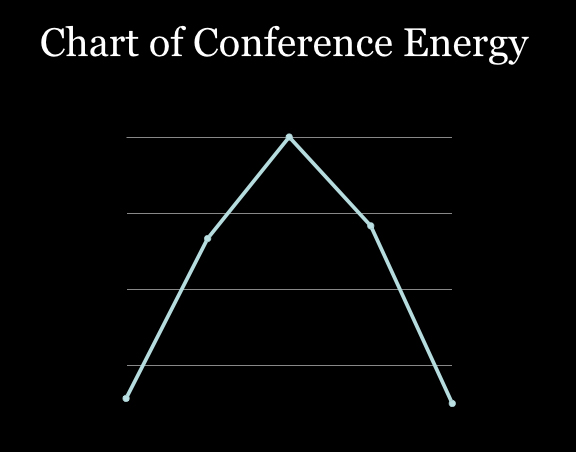
If you made a chart diagraming the positive energy effects of the event, it would look like this:

chart

Somewhere in the middle of the event, usually at the sponsored reception, is the peak of the community that forms around that event. It’s the moment when:

  • The most people are in attendance
  • people have had half the event to meet and engage with people
  • It’s the easiest socializing,as there’s booze, food and everyone there is there to socialize
  • People can still look forward to the second half of the event

But as time progresses towards the last session, that energy  falls. And when the event is officially over, there’s a user experience cliff where you are instantly returned to being on your own again, sadly divorced from the bonds you just formed, much like a child getting on the bus to take them home from the last day of summer camp.

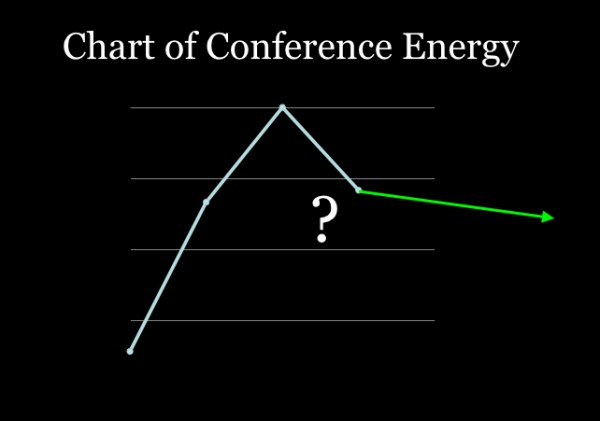
What I’m wondering is, what can conferences do to make it so the chart looks more like this?

chart2

A list of obvious things events can do include:

  • Opt-in mailing list or Facebook group for people to continue the conversation
  • A follow up email the day the event ends, with links to slides and resources
  • A check-in email one month after the event, to see how folks have applied what they learned (there’s good feedback here for the event as well)
  • A happy hour a month after the event to reunite locals (or done in a google+ hangout)

Have you seen smart or well done ideas at events for getting closer to this goal? Or that help attendees get the most value, now that they’ve returned to work, from the event that just ended? Leave a comment.

What does a good father do?

What does a good parent do for their children? What specifically, if anything, can only a father do for a child?

It’s an easy question to ask, but complex to answer. Much of what we have in our minds about what good parents do, or don’t do, is based on our own experiences. Since we only have the two parents we’re born with, we depend on secondary sources to evaluate the ones we have: the parents of friends and cousins, television shows, books and movies. And only as we grow into adulthood do we have enough context to see our parents in a broader light, including perhaps the light of the experience of being parents ourselves.

This was research for for my book The Ghost of My Father. Without falling into the traps of genders, many of the things good fathers do fall into the general pile of what any good parents does. In drafting this post I wrote many lists about fathers, but in revising I realized much of these lists were really about parenting, and not gender or role specific.

Things good parents do: 

  • Keep the family safe
  • Provide financial resources
  • Provide opportunities for children to learn and grow
  • Set examples of good behavior
  • Enforce rules that are fair
  • Are present and happily available with their time
  • Create the first healthy emotional relationships children will have
  • Model conflict resolution, introspection, goal setting, patience, civic duty, and more
  • Be reliable and committed

Things good parents encourage in their children:  

  • Developing independence and confidence
  • Being trustworthy
  • Having self-discipline and commitment
  • Desire to be helpful
  • Learning useful skills
  • Following the child’s own dreams and ambitions

This list applies regardless of gender. A single parent could do these things, or two parents of the same sex. What then is the exclusive domain of fathers? What things can fathers do that mothers can not?

Things good fathers do: 

  • Teach skills important to boys for becoming a man: self-discipline, sports, grooming, how to make friends. A man or woman could certainly teach these skills if they had them, but perhaps there would be elements missing that only a man would be likely to know?
  • Model for girls and boys what a good man is like (trustworthy, respectful, skilled, self-disciplined, confident but humble). But aren’t these just traits of any good person, regardless of gender? Is there some specific element of the idea of man-ness that only a man can demonstrate?

What’s missing from these lists? Or am I wrong and there are more things only fathers can do?

How To Convince Your Boss To Try Something New

Powerful people often become conservative. Once they’re in charge, it’s easy to feel that the knowledge that helped them rise into power is all they will ever need. This means that despite the platitudes about wanting new ideas, many bosses are hard to convince to try new things.  They have more to lose now, so their preference for the status quo increases.

We read books, take courses and go to events, often with the support of our bosses, under the pretense change is possible. But often they find ways to kill ideas, gently or passively, and not much happens. It often takes a different way of approaching the problem to get a powerful person to do something new.

Here’s a quick guide for how to convince your boss:

  1. Have a great reputation. The best leverage you have with any boss is your performance. They’re more likely to consider suggestions from the highest performing person on the team than the lowest. Before you present the grand revolutions you want them to lead, make sure you’re in good standing. Be patient. Match the size of your suggestion to the quality of your reputation.
  2. Consider what problems your boss needs to solve. Don’t start with your problems or what things you want to try. Instead think about the world from the perspective of your boss. What are their goals? What do they need to do to succeed? What achievements are they striving for? What will get them promoted? A good pitch is based on the catcher.
  3. Match what you want to try to their goals. Frame anything you want to try in terms of how it might help your boss. Will it have a chance of helping reach their sales quota? Will it help them get better clients? Will it save them budget? At minimum, think about your own productivity and morale: why should your boss care about improving these things? Consider that and make it part of your pitch. You may discover that there are far better things to suggest than the idea you originally had.
  4. Get support from respected coworkers. If your idea is good you should be able to get a coworker or two to also want to try it. Provided the boss respects their opinion, their interest helps support you. In some cases it might even be better if someone other than you makes the pitch. If you have a good relationship with the peers of your boss, especially peers they respect, consider trying to get them involved.
  5. Look for books and respected organizations that support the thing you want to try. Find companies your boss respects that already use the practice you have in mind. There are often books and papers that can help support your case. Of course getting your boss to read them is another matter, but your consumption of them will better inform you of answers to questions your boss is likely to have, and most importantly, refine your own thinking about the realities of the thing you want to try. Maybe it’s not such a good idea. Or perhaps there is a different way of thinking about the problem that’s more useful.
  6. Plan for a trial. Minimize their sense of risk by suggesting you try the new thing on a trial basis: a week or a month. Also propose a list of criteria for how to evaluate if the new thing was successful after the trial is over. If you’ve never pitched your boss on anything before, pick the smallest simplest version of the thing you want to try. Minimize the risks and earn some trust for the next time you have something you want them to try. Pick a safe and small project that has the fewest risks, or that is only of moderate importance.
  7. Make the pitch. Remember that most people in power respond differently to pitches when they are in front of a group vs. when they are by themselves. Find a situation that provides the best opportunity, based on when your boss is most responsive to suggestions (email? in your performance discussions? at coffee?) Define the problem (in terms the boss relates to), offer the solution, define the (trial) terms, and reference what other companies already participate. Observe how other people pitch your boss and what tactics work best (See: How To Pitch An Idea).
  8. Work very hard to make the trial work. Your future reputation is on the line in the trial. If the trial goes well, and they agree to the change, you’ll be in higher standing for the next recommendation you make and convincing them again will be far easier. If you fail, and fail badly, it will be harder to earn their trust next time. Do everything in your power to make sure that failing all else some useful lessons are learned, enabling the argument that doing trials, even if they fail, have minimal risk and provide new lessons for the organization. Including the discovery of new trials to do that might have better results.

In the end, it shouldn’t be all that hard to convince a smart, wise, progressive boss to try new things on a trial basis. If you realize that your boss is impossible to convince, the thing you might need to try is looking for a new boss to work for.

Related:


How do *you* eat Pho?

I rarely write about food here, but eating and cooking are two of my favorite things. Pho, Vietnamese rice noodle soup, is a pleasure I discovered more than a decade ago, when I went gluten-free for a time and struggled to eat anything anywhere. I’ve always loved noodles and it was a perfect match.

I’ve eaten it regularly ever since and it’s staple here in Seattle with dozens of places that specialize in it (the soup and where I’ve eaten it are even mentioned in the acknowledgements of Confessions Of A Public Speaker).

What I don’t like about people who write about food is pretense. The pretense that there’s a wrong way to eat. I have two rules about eating:

  1. It is your mouth – put in it what you like, not what an expert (who has their own maw to fill) says
  2. It is your money – you paid for it, eat it how you like

Of course you should experiment with different foods and different ways to eat things, and experts can help offer good experiments to try first, but only to discover what you enjoy. Everyone’s palate  and tastes are different.  Rules for food are for fools.

And now, Pho.

IMG_9809

Pho is traditionally served with many ingredients for you to use as you please: bean sprouts, basil, lime, jalapeño, and at least two sauces, a hot Srirachia sauce and a sweet and salty Hoisin sauce. It’s quite a taste chemistry set and you’ll see many people who have very specific cauldronesque recipes for their pho.

I’m a simpleton: I taste the broth first, then put just about everything in (except basil which is rarely worth the effort), a shot of hot sauce, a shot of Hoisin, and I’m off and running.  Maybe less sauce if I think the broth is great, maybe more if it’s not so impressive. I use the chopsticks for noodles, and sometimes drink the some of the broth at the end.

It’s no surprise all the experts have their laws, rules and traditions to which i say hooey. Traditions are great to try at least once, but you should always remember every tradition we have was invented by someone who tried something different than what had been done before:

My question for you is: how do you eat your Pho? Leave a comment.

How Remote Work Improves Diversity

A good question about The Year Without Pants: WordPress.com & The Future of Work from Sibylle, in a comment:

I was wondering how you think Automattic’s model would work for a more diverse workforce. The culture you describe in the book is very much centered on young, male, tech-savvy, western-socialised software developers. I was envisioning myself (female, a generation older, and while working in the tech world, not a technical person myself) in that specific culture and imagined I’d probably be rather miserable. :)

Do you think this kind of approach can still be effective with teams from many diverse backgrounds, different ages, cultures, languages, etc.? What would have to be tweaked?

One tradeoff of the book’s intimacy into the team I lead is you learn more about my team than others in the company. Automattic is in fact pretty diverse, at least for a tech company. Perhaps what you learned is you really don’t want to work with me? :) Which is fine of course.

Putting Automattic aside for the moment, remote work has many benefits regarding diversity:

  • People see only your output. Most of what I knew of my coworkers was the designs they made, the code they wrote, the blog posts they drafted, and the things they typed or said in conversation. If I had a bias against someone’s age, gender or height, those elements were invisible to me most of the time. Or more powerfully, it was very hard to hold onto bias in the face of unignorable productivity.
  • No one hears your accent when you type. Remote work often hinges on written communication. No one can hear your accent when you are typing. While excellent communication skills become critically important in remote organizations, everyones typed words read the same.
  • You often discover people’s appearances only after you’ve worked with themIt’s common in remote organizations to spend weeks or months working with someone before you meet them in person. By the time you do, your opinion of them is based on their performance, unbiased by any biases you have.
  • Remote workers can be hired from anywhere. Since no relocation is required, anyone can be an employee. If people can work from home or a coffeeshop, they could also work in China or Portugal. Hiring employees from other countries doesn’t guarantee diversity, but it raises the odds significantly, certainly along geographic and cultural diversity lines.

Of course hiring remote workers doesn’t guarantee diversity unless the hiring process minimizes bias.

Specific to Automattic:

  • On gender diversity, When they were @ 180 employees, they had 39 female employees, ~21%. (They’re closer to 250 now).
  • On age: I was a generation older than most of my team and still not the oldest employee there
  • Because they hire by trial, a candidate’s performance is the primary criteria, minimizing the potential for discrimination
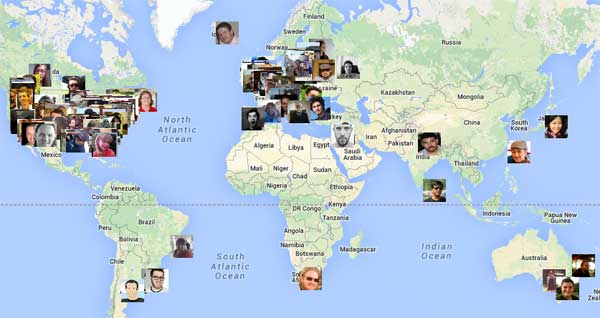
  • They have employees in over 120 cities, and 30 countries (you can see a map here)automattic_map

In the section of  The Year Without Pants on Results vs. Tradition I strongly make the case that superficials like how we dress, or who works late, are distractions, but I should have driven the point home harder that remote work helps reduce gender, age and other biases, since you see far more of a coworkers output than their outward appearances.

There’s a Free Webinar on Remote Work & The Year Without Pants on 3/27: Register here.

Free Webinar: Future of Work & The Year Without Pants (3/27)

Next Thursday Citrix will be hosting me with a live webinar about remote work and The Year Without Pants. It’s completely free, and I promise it will be fun.

  • Date: Thursday Mar 27, 2014 | 10:00 AM PDT
  • Hosted by: Citrix
  • Register here

If you’ve read the book and have a question you want me to answer, leave a comment and I’ll try to cover it.

You can see some of the previously answered questions here or download the free chapter from the book.

Hope you’ll join and spread the word. Cheers.

Signed copy of The Year Without Pants to First 10 commenters

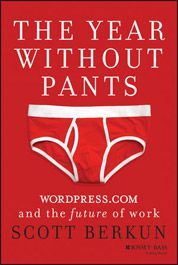
YWP-sidebarHi folks. Its been a long time since I gave things away.

Some of you subscribe directly by email (“Get Posts Instantly” in the sidebar) or RSS to every single post. That’s swell of you.

As a small token of thanks you get the first shot at this. I won’t hit the social media thingies until later today.

The first 10 people (in North America, sorry rest of planet) to leave a comment will get a signed copy of The Year Without Pants, an Amazon.com best book of 2013.

Bonus: I’ll also pick another 5 additional commenters at random to get a book, so if you’re late, leave a comment anyway. You might still win!

Thanks for reading and supporting my work.

Silicon Valley’s Youth Problem & The Myths of Innovation (NYTimes.com)

This essay in the NYTimes, Silicon Valley’s Youth Problem by Yiren Lu, is a kaleidoscopic essay on culture divide, and the angst of being smart, young and successful in Silicon Valley. It’s a well written but strange essay in that she seems unsure about where she lands on many of the issues she’s raising. It also suffers from her youth, which is fair given that that’s what the essay is about.

Why do these smart, quantitatively trained engineers, who could help cure cancer or fix healthcare.gov, want to work for a sexting app?

If Sean Parker, Mark Zuckerberg, and (young) Bill Gates are your heroes, your choices are obvious to you. But there are also plenty of social startups, ventures aimed at doing good as well as profiting, but Lu doesn’t mention them. And that’s her primary blindspot: she sees dichotomies on age and attitude, rather than spectrums.

He does answer her own question later – identity:

As an enterprise start-up, Meraki has been impeded by its distance from the web scene. It simply does not have the same recognition as a consumer company whose products users (and potential recruits) interact with every day. “You say, ‘I work at Pinterest,’ and people know what that is — they use Pinterest,” Biswas said. “You tell them you work at Meraki, and they’re a little more reserved. They’re like, ‘What’s that?’

The company you work for is an easy way to impress people and impress yourself. If you value this where you work hinges on how popular the company is, not what it does or what contribution you might be able to make there.

Before the web more bright engineers chose to stay in academia where they could work on problems that took a long time to solve, if they were solvable at all. The financial and cultural rewards today for leaving school and joining a startup has shifted that balance away from long term work (or for doing that work in academia, rather than a corporate research lab). Those pressures have always been there but they’ve intensified.

Scientists, including computer scientists, argue real innovations are fundamental developments like the laser, the satellite, the mouse, Ethernet, cellular networks, WiFi, even Object Oriented Programming. These are contributions that took years to develop and provided a breakthrough that enabled thousands of other inventions, including the web. And by developing these ideas in academia they become available to the world, not a corporation. What inventions does your average startup enable for the world? Usually none. Most startups die or are acquired and mothballed, their IP locked forever in a corporate cave.

Lu correctly mentions that the Web has made the barrier to entry for starting companies and releasing applications lower than ever in history. She writes:

“The sense that it is no longer necessary to have particularly deep domain knowledge before founding your own start-up is real.”

That alone explains the draw for anyone with ambition: for the first time in history you can launch a product to the entire planet in 6 months with the primary expense being your time. Many of these startups hope to become a fad, a viral trend, which means they are shallow by design. Many have the primary goal of simply learning what they are capable of and starting a company is a great way to do that.

But the typical startup is very high up on the tree of innovation, providing little for others to build on, and capitalizing on contributions from hundreds of forgotten people. There is little wrong with this, it’s just not interesting on the scale of the future if you are interested in more fundamental kinds of progress.

Dalrymple’s description makes sense, but its implied recommendation — that new and old need to embrace each other — is difficult to put into practice. Several of Cisco’s previous attempts to reach out to the new guard, like the Flip video camera and the Cius tablet, were busts. The phrase that’s constantly repeated in the valley is “innovate or die.” Innovation, everyone seems to agree, is the answer. The problem is that so many “innovations” — Intel’s “creative collaboration” with the rapper will.i.am, for instance — are just some stuffy vice president’s approximation of cool. That is to say, they’re hardly innovative at all.

Lu gets lost in the meaninglessness of the word innovation. The fact that a product was a bust doesn’t mean it necessarily failed at breaking new ground or developing new ideas, it merely means it failed in the marketplace. And celebrity collaboration is marketing, as it’s generally paid for by marketing and advertising budgets with the singular goal being attention.

These failures say nothing about the challenges of old and young. While the average age at Cisco, IBM and Microsoft are much higher than Google or Facebook, all of those older companies successfully hire thousands of top new graduates every year: they are simply graduates who have different ambitions and values. However I’d agree with Lu it’s less common to see older engineers join startups, but the reasons for this are multiple and she mentions some of them in her meandering way.

Many people crave opportunity. Many people crave stability. Some of this is linked to age, but not all of it.

The success of self-educated savants like Sean Parker, who founded Napster and became Facebook’s first president with no college education to speak of, set the template.

Lu desperately needs to read about survivorship bias and that a hero is not a template. A hero can be an inspiration but should never be used, without careful examination of others who did nearly everything the same as the hero did but failed, as part of a trend or a playbook.

In perhaps the most ignorant notion in the piece, Lu quotes a friend:

“Never before has the idea itself been powerful enough that one can get away with a lacking implementation,” she wrote. Her remark underscores a change wrought by the new guard that the old guard will have to adapt to. Tech is no longer primarily technology driven; it is idea driven.

This is hubris and youthful ignorance doing a blindfolded dance together. Lacking implementations is precisely what startups have shipped since the beginning of software startups (now approximated and acronymized as MVP). The web itself began with a shockingly limited feature set compared to desktop publishing tools at the time (or arguably, even now). The web had to reinvent table layout, only to abandon it years later in favor of an approximation of the kind of positioning system that had been around for years.

For the last 30 years everyone has bemoaned how Microsoft succeeded with third rate engineering. Or look at ShamWow or hundreds of other hyped ‘inventions’. The very notion of advertising can be cynically defined as ideas trumping implementation.

The lesson from innovation history is the best idea doesn’t necessarily win. Nor does the best implementation. You can do everything right and still fail, and do many things wrong and do very well. Marketplaces are chaotic and unfair. The personal lesson here is if you place meaning on success in the market, you will always be chasing meaning instead of making it for yourself.

The First Time I Saw The Web

In honor of the 30th anniversary of the web, here’s my story.

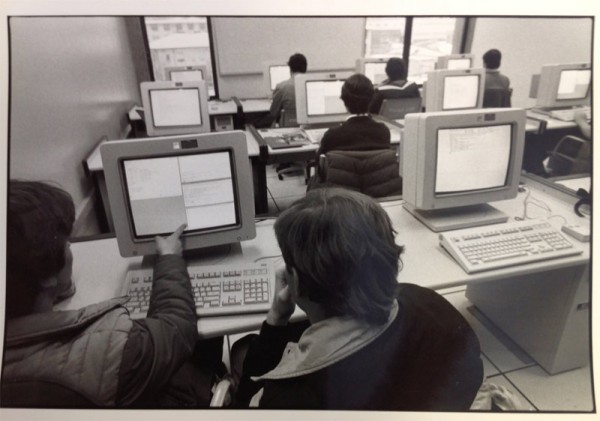
I was a senior at CMU in ’93/’94 and for my computer science classes I spent many long hours in the computer labs, called clusters, working on programming projects or doing other schoolwork. Many of my friends hung out in clusters and it was common to see new software friends had found, or in some cases, made. I worked mostly in the Unix rooms, where all of the DEC and Sun workstations running X-Windows were, including their hockey puck shaped mice.

cluster

Late in ’93 or early in 1994 I remember being in Baker Hall, one of my favorite clusters, sitting in the back row (the photo above is from Ween Hall, a similar cluster, via CMU Archives, analysis). I wasn’t enjoying whatever I was doing so I looked around the room. Someone had a window open on their workstation with all sorts of images and text in it, and I asked him what it was. He told me it was Mosaic and he told me how to install it, which I did. I played with it for a few minutes, found it cute, and didn’t touch it again. There were only a few hundred websites and most of them were junk.

There were no search engines. There were no maps or guides. The joke was “There is nothing worthwhile on the web, and you will never find it anyway.”

Here’s how few websites there were, by year:

  • 6/93: 130 websites
  • 12/93: 623 websites
  • 6/94: 2,838
  • 12/94: 10,022
  • 6/95: 23,500
  • 1/96: 90,000
  • Today: 1.8 billion
  • Source: [source]

What I can tell you is NO ONE thought much of the web at the time. I didn’t know a single person anywhere, in school, real life, or online, who thought this would ever become something mainstream, much less dominate the future, as the walled garden of AOL dominated how ordinary people interacted with each other online.

That year I read the first issues of Wired magazine, and even wrote for them, and they barely mentioned the web either. It just felt like yet another odd academic project, with few people using it. The Internet, meaning email, gopher, telnet and newsgroups, was something I’d been using in class for years (including The Andrew Project). I’d worked with Hypercard, Director, and studied different forms of hypertext tools in class. I knew about Project Xanadau.  This “web” just seemed like yet another thing. And HTML, wasn’t even a proper “language” with barely any functionality other than crude text, links and images.

I remember eventually visiting the Yanoff page. It was what other people told me was the “best place to start with the web” (This is the only image I could find of Yanoff’s page, shown in the Windows version of Netscape).

yanoff-list

I was hired at Microsoft in 1994, and in early 1995 joined the Internet Explorer 1.0 team (where I’d work until version 5.0). Even then the web was far from mainstream. It was progressive for Windows to have a web browser at all, even though the first version shipped only in The Plus pack, along side screensavers and utility programs.

It wasn’t until the browser wars of 1996-1999 that the industry first shifted to focus on the web and the Internet, and only as society shifted from using dial-up modems to broadband, and eventually mobile devices, in the 2000s did it become central to most people’s lives. It wasn’t until 2001 that AOL saw it’s subscribers decline as direct access to the web became commonplace.

Lesson: The future often looks strange in the present. Any idea with the power to transform the world won’t make much sense at first. This is one of the best lessons from the history of innovation: if you want to be part of the future, keep weird stuff around.

When did you first see the web? Leave a comment, or write a blog post about it and I’ll link to it.

[Updated March 12, 2019]

The Three Writing Mindsets

I write nearly every day and I have the hypothesis that there are three writing mindsets. Put simply:

  1. Raw. When I wake up from a dream, or share a meal with someone interesting, I have a surplus of ideas in my head. Often they’re strange, sometimes they’re interesting, occasionally they’re brilliant. In all cases they are fragments of ideas: phrases, concepts, images, memories. They could be anything, ideas for books, or systems of government, or a new kind of terrible spray cheese product. I know I can’t predict what idea will lead to what other ideas, so I write down tons of the raw thoughts that cross my mind. I have many places for capturing the raw things that come out of my mind. I have a pad by my bed, a small notebook with me all the time and a digital journal.
  2. Run. When I’m developing a specific post, essay or chapter, this is the mindset that lets me build a narrative, find a theme, and run with it for as long as I can until it dies out. Sometimes I can run with a thread for pages. Sometimes I barely get through a paragraph. But unlike Raw, with Run I stick with the same idea for as long as I can and continue trying to make it work.
  3. Review. When nothing else works I review. I reread from the start. I fix things. I change the order of points. Sometimes I change bigger things like the order of paragraphs, pages or chapters. Sometimes I fix little things like spelling or grammar. This is editing, in that I’m primarily working with what’s already there. If I’m reviewing to avoid running, I try to review only long enough until I have an idea and the confidence to start running again (saving real editing for the big read).

Some writing sessions involve moving between these three mindsets frequently. I might decide to scrap an entire chapter or add a new one (Raw), or pick up a side path and make it the focus (Run). To do either of those tasks might require me to reread entire sections (Review) before I can hold enough of it in my mind to make a Run.

There are good days where I balance the three mindsets well. On other days I get lost on one particular run on something that in reality is a tangent, and I won’t know it until the next time I sit down to review the whole creation. Now and then I find myself obsessing about a detail (Review) far too early, when then entire piece isn’t developed enough to justify polishing.

Often I can control which one I want to use and it’s a choice. When I sit down each day I often know where I left off yesterday. I begin the writing session I already have in mind what the next session needs to do. Other times I have trouble continuing, and need to write freely in my journal just to get the exhaust out of my brain (Raw). But on some days I’m a slave to my mind, when it wants to Run, or wants to be Raw, even though the task at hand is to Review, I sometimes let it have its way.

I always have projects at different stages lying around. If I can’t concentrate on the mindset one project needs, I’ll at least go and review something, or continue a Run (e,g, a half-written blog post) I abandoned weeks ago, until I sort out what is distracting me from what i want to do. I try to never let myself do nothing: there’s always a way to use whatever state of mind I have to my advantage. At minimum I can do some research on the project (a kind of review, just of other people’s work). But I know on some days the escape from having any conscious mindset at all is what I need, and the solution is to go for a run, chase the dog, have a beer with a friend and see where my mind is the next day after my body has had its way.

[This post was 1% Raw, 74% Run, and 25% review: I wrote it in 25 minutes just now, while avoiding a much larger writing project]

Remote work @ WordPress.com by the numbers (Infographic)

[Update: I learned a lesson about infographic spam after posting this]

Here’s a quick visual rundown on remote work and WordPress.

They got a handful of things wrong:

WordPressInfoGraphic

Have we reached the death of the author? (Publishing and Poverty)

I’m a fan of Melville house, a young, savvy publishing company founded in 2001 in Brooklyn, NYC. They have a lively twitter feed, they publish interesting books, and generally seem wise about what books and book publishing mean in this technological age.

But a recent article of theirs titled Publishing and Poverty by Zeljka Marosevic, their director of UK Marketing, reflects a flawed romanticism about writers: there was never a good time to be one.

The writing life has always been hard, especially for writers of fiction. Even Hemingway and Fitzgerald had a hard go of it at times. Dickens saw most of his profits lost to piracy and, like Twain, earned more from speaking engagements than his books themselves. Even when the novel was at the center of European or American entertainment, it was still the rare novelist that survived by their writing alone, and those that did achieved it at great risk and with consequences to their health, their families and their wealth. Many famous writers, from Mellville to Kafka, became famous after they died. They never experienced the full attention their works generated, a fate common for many artists (e.g. Van Gogh). Da Vinci is far more famous today than he was during the Renaissance. Being an artist has always been a hard road.

Marosevic mentions a story of British author Rupert Thompson:

Rupert Thomson, who is being forced to abandon the office he hires in exchange for converting his attic into a “garret” to save money. Due to falling advances and physical book sales, combined with publishing’s move to digital, Thomson feels fearful about his future as a writer: “I don’t buy anything. No clothes, no luxuries, nothing. I have no private income, no rich wife, no inheritance, no pension. I have nothing to look forward to. There’s no safety net at all.”

He had an office? What a luxury. What percentage of writers throughout history had them? And what is this talk of safety nets? If an adult wanted a safety net, why on earth would they choose to be a writer? Now mind you I’m all in favor of good writers who need support getting it if they can. I’m a member of the Author’s Guild and I support programs that support writers. However to choose to be an artist is to deliberately reject the security that comes with nearly any other profession. It’s to be expected that to structure a life around writing will be a challenge.

She comments on the recent London Author’s fair:

Their education seemed more to be about learning to market themselves than becoming better writers. Unless that’s what it means to be a good writer today. No vision seems satisfactory, and with the decline of the old and the dawn of the wobbly new, a writer’s place seems highly insecure.

Throughout history there have always been more authors looking for a break than publishers can afford to give. Even Mellvile House itself does not accept unsolicited fiction submissions. It should be no surprise that when writers convene, much of their conversation is about marketing: publishers demand writers market themselves to the publishers! That’s what agents, book proposals and synopses are for. The entire machine of the publishing industry depends on writers marketing to publishers. And until the technology of the last decade they’ve had the keys to the only gates (now we all have gates on our phones).

Publishers today, and probably always, desire writers who are excellent self-promoters. Walt Whitman went too far in writing fake reviews of his books in newspapers, but the spirit was always desirable. Authors are chosen in part for their platform, jargon for how famous they are. That fame is assumed to translate directly into marketing, and it’s common now for publishers to ask how many twitter followers or blog readers a would-be author has. This is not a shock, it’s logic. Publishing is a business. To choose  an author already known minimizes risks and publishers, more often then not, play it safe, especially when deciding between two equally good manuscripts.

Beyond my critique, I believe without question this is the best time ever in history to be a writer. It is still hard, but today we have more tools in our possession to publish, to collaborate, to market, than any writer in history ever had. And most of these tools are free! There is simply no one to blame. Can’t find a publisher? Publish yourself. It’s cheap. You can’t blame ‘the system’ anymore. Don’t know an editor? Hire one. Don’t have money for it? Save. If you are so passionate and talented you will find patience. Don’t have any followers or fans? Start a blog – a blog is free and instant publishing to the planet. If as a writer you can’t get excited about publishing anything you like to the entire planet for free I question your sanity. This is as good as it will ever get.

Most of what’s published is trash, it’s true, but this means if you are talented and dedicated your work will shine. It’s unlikely to shine brightly enough to be the way you make a living, but as I’m telling you there was never a time this was likely anyway. Do it because you want to do it, not because of some reward you expect from the species. Your talent might have been granted to you, but it must be proven, through hard work, to the rest of the planet.

Publishers can be great partners to writers. They can help craft the book and find it an audience. But all they’ve ever done throughout history is help. Only the writer gets their name of the cover and for that privilege comes the lion’s share of the work.  While publishers are allies, a prolific writer finishes a book a year while a publisher will publish dozens of them in the same period of time. The math is simple, in that the most committed publisher will never invest as much in a particular book as the author. All authors should be prepared for this since it has been true since the history of publishing. The author is always at the center of marketing and publicity even when a publisher is fully behind them. But today with Kickstarter, Facebook, twitter and blogs every single person you know can help contribute to, or spread word of, whatever you make and have as much or more influence than publishers had in the glory days (whenever you think those were) for finding an audience for what you make.

The web has rekindled the old complaints of giving work away for free, or competing with people who work for free. It’s hubris. Bakers, brewmasters and cheesemongers give free samples, why not writers? You end up doing work for free in any profession where supply outweighs demand. Actors, musicians, poets, painters and writers struggle because thousands of people want to do these things. If you don’t want to compete with people who will work for free, you must choose a kind of work that few people can do. Learn to fix cars or air conditioners and you’ll never work for free. But to chose to write, or paint, or sing, and then bemoan a golden era than never existed shows a lack of understanding of the profession of your passion. Many actors, musicians, painters and writers get paid very well for what they do, but they had to earn it. There are careers available, but you’ll have to scrap and hustle and then get lucky to get them.

I have the ambition to be a novelist. I want to write plays and stories too. But thus far in my writing career I’ve written business and philosophy books. Why? Because these markets are simpler and easier to market to. Magritte worked in advertising for years before becoming famous enough for his paintings to focus on his own work. Director David Fincher filmed TV commercials. Hemmingway wrote for newspapers. You don’t have to do much research to discover how many great talents hustled to develop the skills, the connections and the confidence to become who they became, without any security other than what they scraped together themselves.

I wish the best for writers, and publishers, everywhere, including Melville house. We’re all in this together. The world needs great works and people with the ideas, craft and dedication required to entertain, challenge and inspire us. But lets not kid ourselves about what writing is or how it has always been, and always will be, done. Good luck to you and I hope you’ll wish some to me in return.

[You can read my advice on writing by starting here: How to write a book, the short, honest truth.]

Why Fathers And Children Don’t Get Along

My next book is a departure and a risk. If you want to understand why, read the goal of my life explained.

I’ve been asking questions about fathers and sons my entire life, which makes it no surprise I’ve had a difficult relationship with my father. He is not an easy man to know, but as a child I didn’t know this. And as it is with all families, you can only see your family for what it is once you leave it and look back. It wasn’t until my twenties, when I moved away and started my own life, that I began to understand both myself and my father  and began the work of unpacking our relationship, as broken as it was. So many of the feelings I had about myself weren’t really mine, but feelings I learned to have to try and fit into his world.

My next book, titled The Ghost of My Father, is about this relationship. Particularly the events of the last two years where he, at the age of 70, has chosen to abandon his family. It seems he was never quite happy with his life, or with us, observations he never shared until this last chapter where he tried to move away and start a new life. He had an affair once before while I was a child, with disastrous consequences for the family. And now I find waves of memories, feelings and thoughts from that time have been brought back to the present, memories and feelings that demand being reckoned with.

We think memory is stable, but all my memories of my childhood have shifted dramatically. Different stories from my past now seem far more important, and ones I thought were important now don’t seem to matter at all. I’ve returned to my journals, sifting through to look for more insight into why these memories are with me now, and others are not.

“Memory seems to be an independent creature inspired by event, not faithful to it. Maybe memory is what the mind does with it’s free time, decorating itself. Maybe it’s like cave paintings. The thing is, I’m old enough now to know that the past is every bit as unpredictable as the future, and that memory, mine anyway, is not a faithful recording of anything, and truth is not an absolute.”  – Abigail Thomas, Thinking About Memoir

Last night I watched the film The Return, about a father who returns to his two young boys from a mysterious ten year disappearance. There was something epic about the tones of the film and how fathers factor in many children’s minds as a powerful, ambiguous, possibly unknowable creatures. Certainly not all fathers are like this, but many are. And few of us have the courage to dig into the hard ground of our childhoods, despite our disappointments with our parents, to sort out who we are and who we want to be now that we’re not children anymore.

This 6th book will be my most personal one so far.

  1. If you want to be notified when the book is out, signup here.
  2. You can read more posts about the book.
  3. If you’re interested in this book, leave a brief comment (“I’m interested – go Scott!” works fine). I’ll be in touch as the book develops and is published. This blog won’t be shifting to be primarily about this project, so leaving a comment makes it easy to stay in touch with you.
  4. And of course films, books, and other stories you recommend I read are welcome too.
  5. If you have a related story to share about your relationship with your father, good or bad, I’d be grateful if you left a comment or sent me an email.

Famous programmer Leaves Google Because of Remote Work Ban

Yahoo is a curious poster child for banning remote work, as they’re not a company that’s doing very well. Yet Google has strict policies against it too, as the recent post by famous programmer Tim Bray explained:

As of March 17th I’ll be an ex-employee. It’s an amicable separation in the face of irreconcilable differences: I wouldn’t move to California and Google wouldn’t open a Vancouver office. I haven’t decided what to do next.

Seriously, about remote work? · Yep. Both before and after being hired, I had been asked to consider moving south. I didn’t want to and politely declined. Eventually, the group I’m in politely informed me that staying remote wasn’t an option. I talked to a couple of other groups but my heart wasn’t really in it, because I decided Google’s position was correct.

It’s one thing if an employee is underperforming. It’s quite another to not let a high performing employee try an alternative way to work. That’s one of the big lessons from The Year Without Pants: WordPress.com & The Future of Work (See FAQ).

If a good employee asks to try remote work, or any choice about work habits they believe will help them perform well, why wouldn’t a manager let them do it on a trial basis? There’s very little risk. If it turns out to be disruptive to the team, or their performance is poor, that’s one thing as there would be an actual problem. But why not allow the employee to try? Allowing employees to try encourages them to look for better ways to work, an asset to any organization. Policies that are outright bans of anything rarely make sense as they prevents employees and managers from experimenting and evaluating actual results. Bans end thinking as people stop thinking for themselves and simply carry out a policy, the birth of bureaucracy.

Bray himself felt he would have performed better if he moved, which he was unwilling to do:

I would have been more effective in my job if I’d moved, and probably would have enjoyed the work more

Google’s icy remote work policy is oddly hypocritical as they market Google Hangouts as a solution for people who work from different places around the world.  Google itself does have 70 offices in 40 countries and there’s plenty of distributed work happening, just not on a solo basis. They do allow telecommuting for specific, and short term, workers such as ad-raters. According to the NYTimes Google does allow solo remote work on a case by case basis, and their CFO was quoted in the BBC as saying “[we have] as few as possible”, and apparently these exceptions did not apply to Bray.

Of course there is no singular answer to the question of remote work. Google has done an outstanding job of hiring and keeping talent. Yet by failing to frame the work policy restrictions around performance is a mistake against the philosophy at the core of any progressive company.

The Goal of My Life Explained (tattoo included)

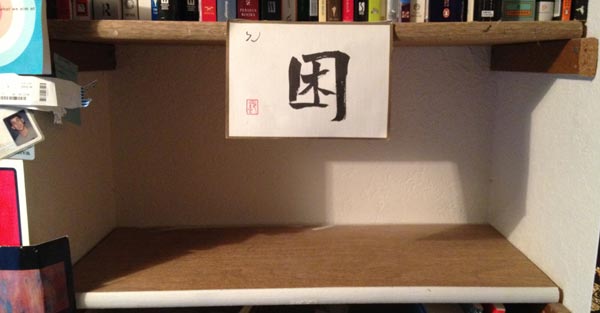
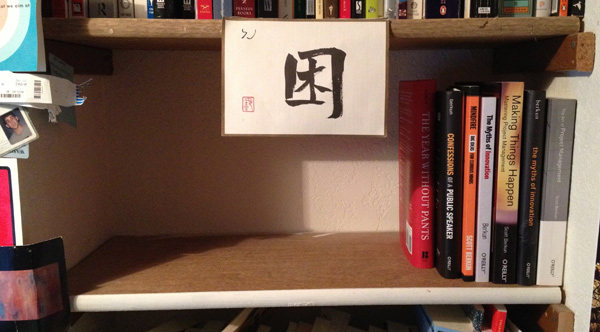
The photo below explains my ambition: I’m working to fill this shelf with books I’ve written. I want an interesting life which requires doing unusual things and having unusual goals. This is mine. Will I achieve this? I really don’t know, but in having this goal I believe I’ll live the kind of life that I want. What’s your big goal? How do you remind yourself of what it is? I find both these questions fascinating and I thought I’d share my answers as it might be helpful to help you figure out yours.

When I quit my first career as a tech manager in 2003, I primarily wanted to try another way to earn a living. I was afraid if I didn’t try I’d have the same career forever and that scared me. What else is out there? I felt I owed it to myself to try and see what I could possibly do and who I could I might become. I was lucky that I had a window of opportunity to try (no kids yet, little debt) and thought those that don’t would probably tell me I was foolish not to take a shot.

Books had changed my life many times and I wanted, hopefully, to write books that helped other people in a similar ways. Since I saw the shelf many times a day (it’s to my right as I type this) I decided it was the perfect spot to have some kind of reminder. Even when I finished a new book, the reminder would always be there. When my first book was published in 2005 I put this simple photo above on the author bio page.

It’s a cliche for Americans to swoon over Chinese symbols, misunderstanding what they mean and not bothering to study their meaning or context. As my Chinese speaking friend Jeff likes to joke, “Uh, that symbol tattooed on your arm doesn’t mean Great Love, it means soup dumplings.” I did my homework and understand its legitimate meaning (often used to mean sleepy, or something that’s kept hidden or locked away), but it also has a specific meaning to me.

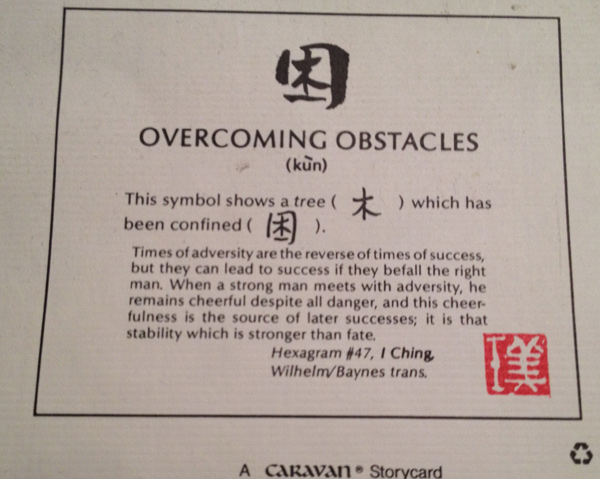
Around the time I decided to quit, which took me over a year to work up the courage to do, I found this card at Uwajamaya in Seattle around the time I quit my job. I liked what it claimed the symbol meant (see below). I love the quiet strength of trees and it matched how I needed to be to reach my goal. The I Ching references the symbol as Hexagram #47, which has various meanings, including the one on the card. I’ve learned in common Chinese the symbol/word is often used to means confinement (one of the other meanings suggested by the I Ching), trouble or sleepy more than overcoming, but that’s OK. The symbol has adorned my shelf for so long it means something specific to me regardless of its common meaning.

bookshelf_symbol_explained

Years later I’ve written 5 books, [8 as of 2020], and the shelf looks like this (see below). I have a long way to go. Translated editions don’t count, as that’d be cheating, right?tag=scottberkunco-20 I’ll need to write about 25 books to fill the shelf which will likely demand most of my working life. That’s fine. I have nowhere else to go and no goal as meaningful as this one.

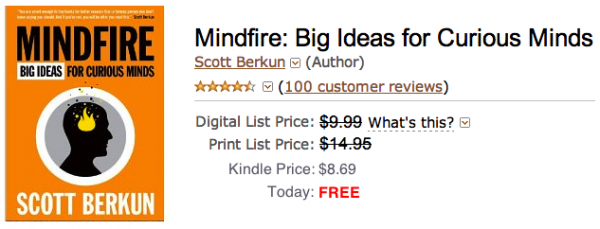
Although it’s a volume goal, I have no interest in writing bad books. I also have no interest in writing unnecessarily long ones. My essay collection Mindfire is comprised of revised essays from this blog, but I’d feel it was cheating if most of the shelf was recycled material. One book in five seems a fine pace for compilations and such.

Occasionally I’m very fortunate to have people interested in hiring me for very nice conventional jobs where I’d have more security and income, but then I look at the shelf. More security and income are desirable, but they have limited bearing on my ability to fill the shelf. So as tempted as I might be, I say no (The Year Without Pants was a notable exception). Writing and speaking are my only means of income.

Another reason I like this goal is writing books demands many things:

  • Polymathic thinking
  • Study
  • Curiosity
  • Passion
  • Connecting with friends and colleagues
  • Making new friends and relationships
  • Commitment to an idea

In the process of writing a book I’m forced to do many things in line with the kind of life that I want: An interesting one. As long as I focus on the shelf, many other good choices are forced naturally.

Most authors repeat themselves, writing the same kind of book repeatedly. The marketplace rewards familiarity and a writing life is hard enough, so I understand why it’s common. Many of our most popular authors publish in narrow ranges. This is wise and lucrative, but also limiting (the most curious perhaps are authors who exclusively write about creativity, which in a way is not very creative). I’m taking the opposite approach for as long as I can. I’ve never written a sequel, because we all know how underwhelming sequels often are. I have no shortage of ideas for books and I’ll keep moving forward until I’m forced to be more conservative, if that’s even possible.

I want to be a writer in the largest sense. I want to be an artist. I want to take big risks with my skills, which will help me discover exactly what abilities I have or don’t have and what good they can do in this world.

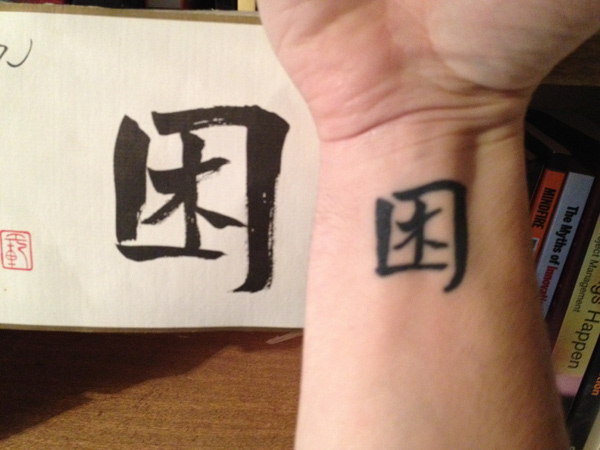
Last year I got my first and only tattoo. It serves as an additional reminder to me about why I’m here and what my goal is. I’m a writer which means I work with my hands. I wanted to keep the symbol with me, near my hands, all the time.

That’s my story. If you see me speak and notice the tattoo, now you know why it’s there and what it means.

Follow As I Chase The Goal

Any encouragement is encouraged. Praise the crazy writer man! And thanks for supporting my work. Best wishes to you on your own goals.

You can follow me on Twitter, Facebook or on my simple monthly newsletter of my best posts each month.